Israel’s Long War on Lebanon
:A Joint History of the Zionist and Lebanese Entities


In the following analysis, Ayman Makarem of the From the Periphery media collective reviews a century of colonial violence in Palestine and Lebanon to illuminate the current Israeli occupation and what it would take to resist it.
You can watch a video version of this essay here.
For the third time in my relatively short life, Israel has invaded my country. They have made it clear that they want to establish a long-term occupation of Southern Lebanon. This is not the first time that this has happened; several media organizations and social media accounts have published timelines of Israeli invasions and attacks on Lebanon. These timelines usually focus on major flashpoints like the 1982 or 2006 invasions, but fall short of demonstrating the full breadth and continuity of Israeli violence targeting Lebanon. Lebanon’s encounter with Zionism goes much further back than most know, predating the establishment of the state of Israel itself.
Let’s start with Moshe Dayan.
Moshe Dayan was an early Zionist leader, born to settler parents in Palestine in 1915. He was present at practically every major landmark event in the Zionist colonization of Palestine. He joined the Haganah—a Zionist militia in Mandatory Palestine—at the age of 21, participated in crushing the Palestinian Revolt of 1936, and fought in the 1948 war, expelling swathes of Palestinians during the Nakba. From the 1950s until his death in 1981, he moved between high-level positions within the military and then within successive Israeli governments, serving as Minister of Defense in the late 1960s.1
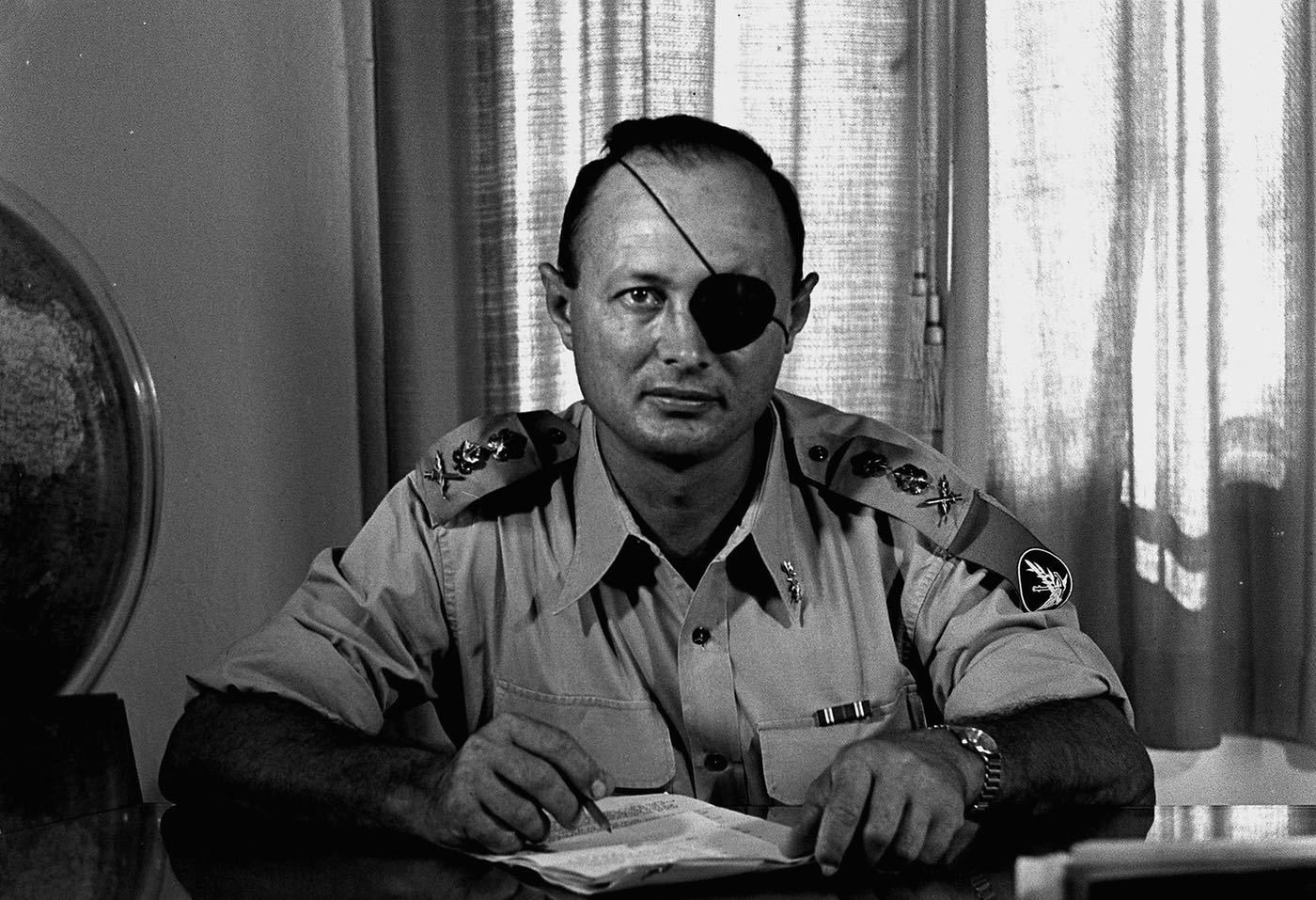
Moshe Dayan as Minister of Defense, circa 1967.
Dayan encapsulates a lot about the state of Israel. A number of quotes attributed to him indicate considerable self-awareness about what he and his colleagues were doing. The words of early Zionist leaders like Dayan cut through the smokescreen of contemporary Zionist propaganda. Here, he describes the foundation of the state of Israel:
“We came to this country which was already populated by Arabs, and we are establishing a Hebrew, that is, a Jewish state here. Jewish villages were built in the place of Arab villages. You do not even know the names of these Arab villages, and I do not blame you, because these geography books no longer exist; not only do the books not exist, the Arab villages are not there either. There is not one place built in this country that did not have a former Arab population.”2
He said this as a person proud of his accomplishments. For those who know the history of Palestine and its encounter with Zionism, that story is very familiar—it’s just notable that it’s coming from a Zionist leader. However, Dayan also said things that reveal parts of the history that are more obscure, parts that are muddied by the tendency to focus on major flashpoints like the Nakba or the Six-Day War.
For instance, in the early 1950s, when he was a Commander of the Southern Command, Dayan developed a policy of dealing with what they called “infiltrators”—in some cases, expelled Palestinians trying to return home or collect things that were left behind when they were forced off their land; in other cases, unorganized Fedayeen militants who would “infiltrate” their own homeland and carry out operations against the nascent Israeli state. This is how he described his policy:
“Retaliation is the only method that has proved effective, not justified or moral but effective, when Arabs plant mines on our side. If we try to search for that Arab, it has no value. But if we harass the nearby village… then the population there comes out against the infiltrators… The method of collective punishment so far has proved effective… There are no other effective methods.”3
There’s another term for what Dayan describes: terrorism. Or still another: war crimes. Dayan’s words shine a light on the periods between the major ruptures, a history that is often forgotten. Between 1949 and 1956, there were tens of thousands of “infiltrations” every year, and Israelis carried out hundreds of bloody retaliatory raids in other parts of Palestine, specifically Gaza and the West Bank, as well as in Jordan and Lebanon.4
In 1955, to put an end to the returnees and attacks from the north, Moshe Dayan, then Chief of Staff under Moshe Sharett’s government, proposed a plan that shocked even his Prime Minister:
“All that is required is to find an officer, even a captain would do, to win his heart or buy him with money to get him to agree to declare himself the savior of the Maronite population. Then the Israeli army will enter Lebanon, occupy the necessary territory, and create a Christian regime that will ally itself with Israel. The territory from the Litani southward will be totally annexed to Israel, and everything will fall into place.”5
This is precisely what the Israelis did 23 years later in 1978, when Dayan himself was Foreign Minister. A few years earlier, in 1974, Moshe Dayan had summarized his goals thus:
“We will make all life impossible in South Lebanon.”6
Moshe Dayan speaking to the press as Minister of Defense in 1974.
It is difficult to not see the parallels with what the Israelis are saying today. It has now been two and a half years since the start of the genocidal war in Gaza, and Israeli leaders have made statements like this over and over again. Since March 2 of this year, Israel has displaced over a million people, claiming they will never be allowed to return, destroyed whole villages, invaded with ground troops, destroyed hospitals and schools, killed entire families, killed medics, and journalists, and academics. Put these together and they spell out one word: genocide. Their main targets are Shia Lebanese.
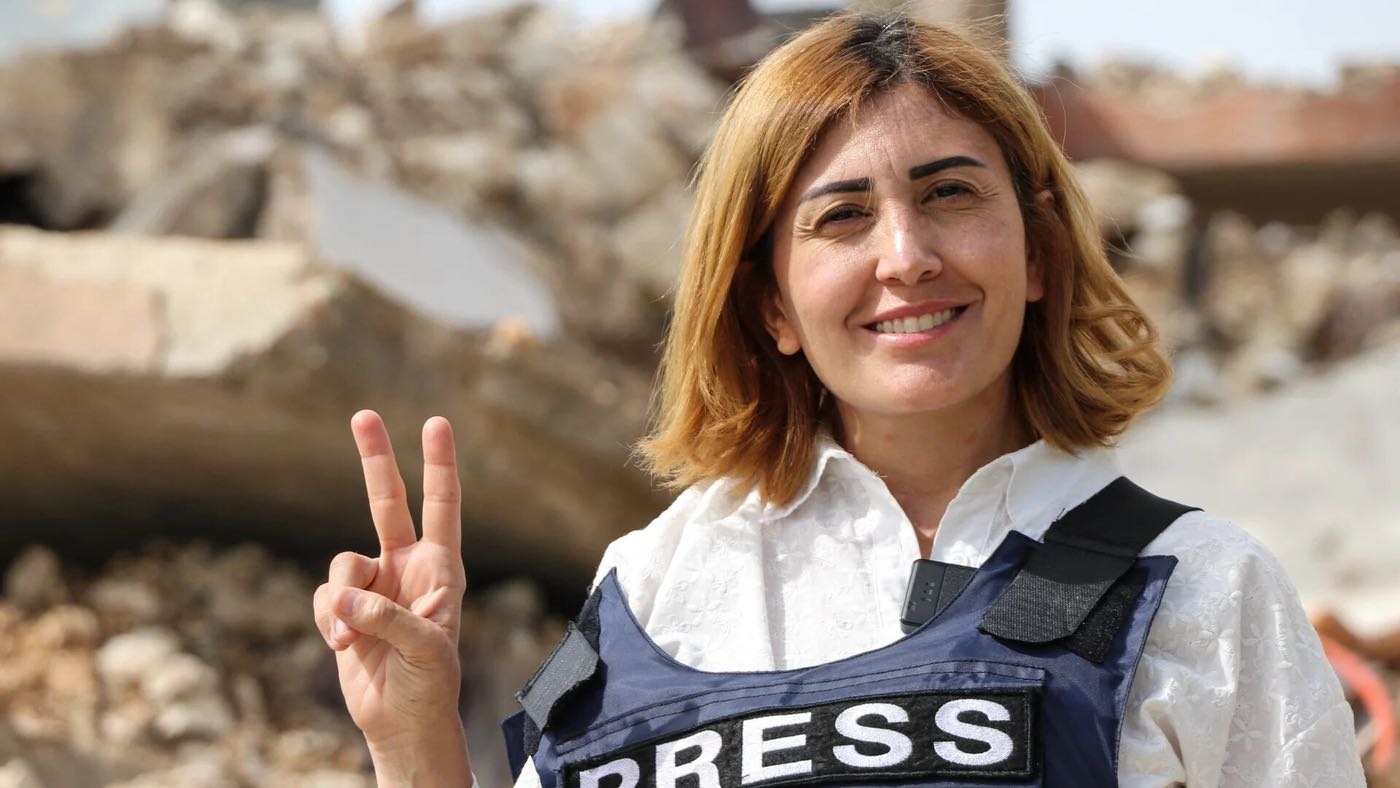
Lebanese journalist Amal Khalil, killed by Israel on April 22, 2026 in a double-tap strike.
With full US backing, the Israeli government is pursuing a policy of genocide in Lebanon. In the last two months, the Lemkin Institute for Genocide Prevention has issued not one, but two red-flag warnings of genocide in Lebanon.
This is an existential war on Lebanon. It has been going on for decades, but now it is reaching its logical end. The Israeli government aims to tear Lebanon apart, to dismantle its capacity to exist. To understand any of this, we have to examine the joint history of Lebanon and Zionism.
A Joint History of the Zionist and Lebanese Entities
The term Lebanese Entity many not be as familiar as the term Zionist Entity, but it emerges from an analysis of the formation of the state of Lebanon that recognizes the colonial relations that formed it and its many structural and exclusionary flaws. These aspects make Lebanon particularly vulnerable to exploitation by the Israelis as well as other regional powers. They have kept Lebanon in a state of perpetual crisis since its foundation.
Here, we will outline a chronological history of the two entities and how they intersect. As an aid, we offer this timeline, which includes Israeli attacks on and invasions of Lebanon alongside key regional events throughout the period that are essential to understanding this history.
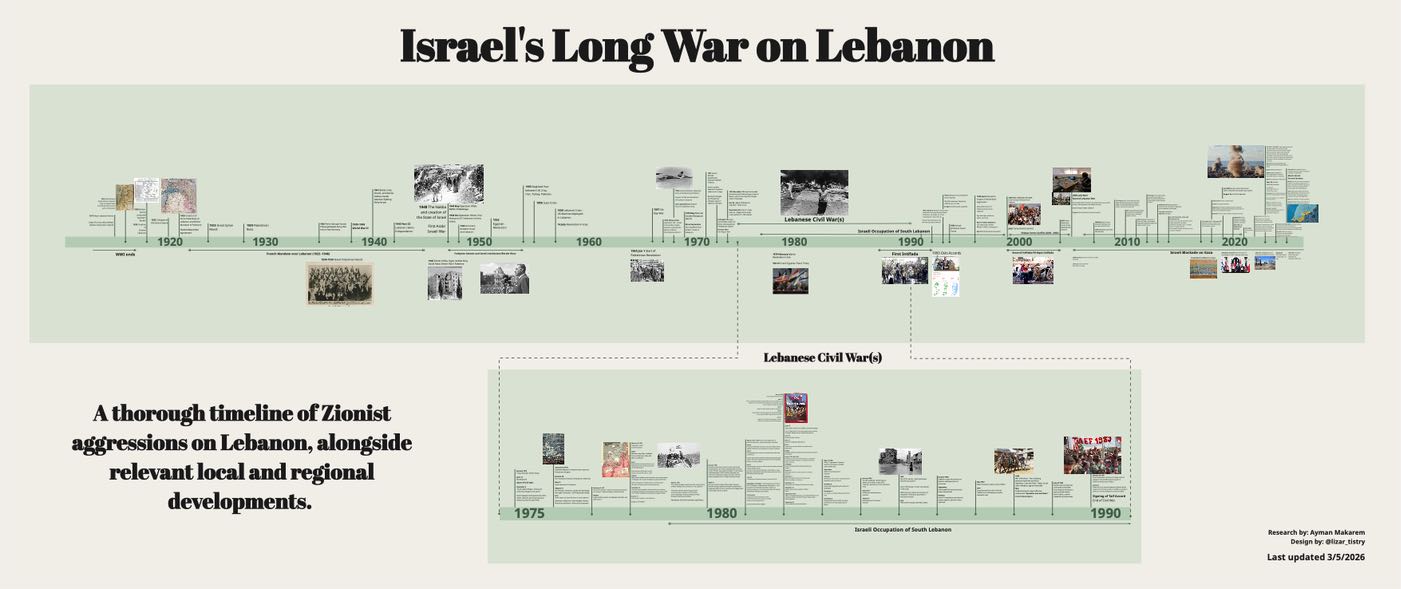
Click on the thumbnail to access the timeline at full scale.
What Lebanon is experiencing today is not just the consequence of Hezbollah’s actions or the Iran War or the presence of Palestinian resistance in Lebanon; it is the culmination of decades of continuous assaults by the state of Israel on our sovereignty itself. We must understand Lebanon as a key vector of the European colonization of this entire region, which the state of Israel has extended and expanded.
We begin this story in the midst of the First World War with the secretly drawn up Sykes-Picot agreement, which mapped out Britain and France’s ambitions in case of a victory over the Ottoman Empire—a victory that came to pass a few years later. What followed remains one of the classic examples of white men carving up Indigenous land in Asia.
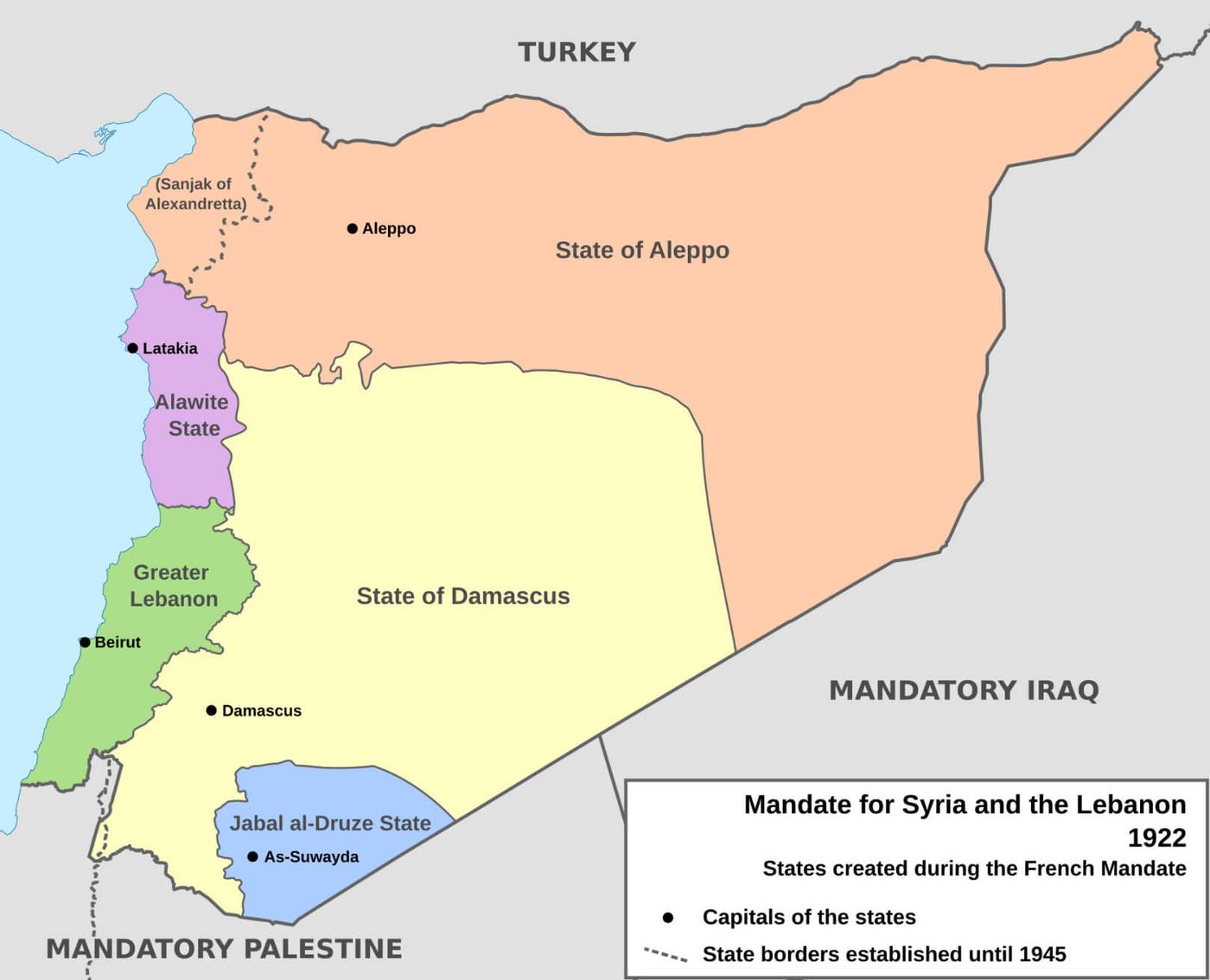
The French mandate of Lebanon and Syria.
Both the Lebanese and Zionist entities emerged out of the ruins of the Ottoman Empire. Both had previously existed as ideas but only became manifest at this point. Lebanon as a state was devised in this period by the French. Palestine, for its part, was taken over by the British, who openly declared their intention to create a Jewish Homeland in Palestine for European Zionists. The key document here is the Balfour Declaration, which was drafted the same year as Sykes-Picot.
The region that the two colonial powers carved up had been known for centuries as Bilad al Sham, which is often translated as “the Levant,” but more precisely translates to “the countries of the left.” If you consider the Arab Hejaz [the western coastal region of Saudi Arabia, where Mecca and Medina are located] to be the center, which it was for centuries of Islamic rule beginning in the 7th century, when you look east towards the sun, Bilad al Sham will be on your left, and Yemen (from the Arabic word Yameen, “right”) on your right. Colloquially, al Sham is also an Arabic name for Damascus, as it was one of the most important cities in the region.
For hundreds of years, Bilad al Sham passed from the hands of one ruler to another. Then, in 1918, European forces conquered the land for the first time since the Crusades. This is where our story really begins.
In 1920, in collaboration with local Maronite elites in Mount Lebanon, France created what is known as Greater Lebanon, a colonial state under French supervision. Before this, the name “Lebanon” referred to the Mount Lebanon range. To this day, older British people sometimes call Lebanon “The Lebanon,” like “The Ukraine” or “The Gambia.” It’s because those names referred to a geographical location rather than a state.
Greater Lebanon was an expansion of Mount Lebanon to include areas around it, specifically the coastal cities of Beirut, Saida, and Tripoli, as well as Akkar to the north, Bekaa to the east, and Jabal Amel to the south. The idea was to separate Lebanon from Syria and the rest of Bilad al-Sham in order to create a viable state led by a majority Christian Maronite population, as the latter was friendly to the French. Annexing those other territories ensured enough farmland, access to ports, and surplus populations for this new state. It also meant access to key water sources such as the Litani River.7
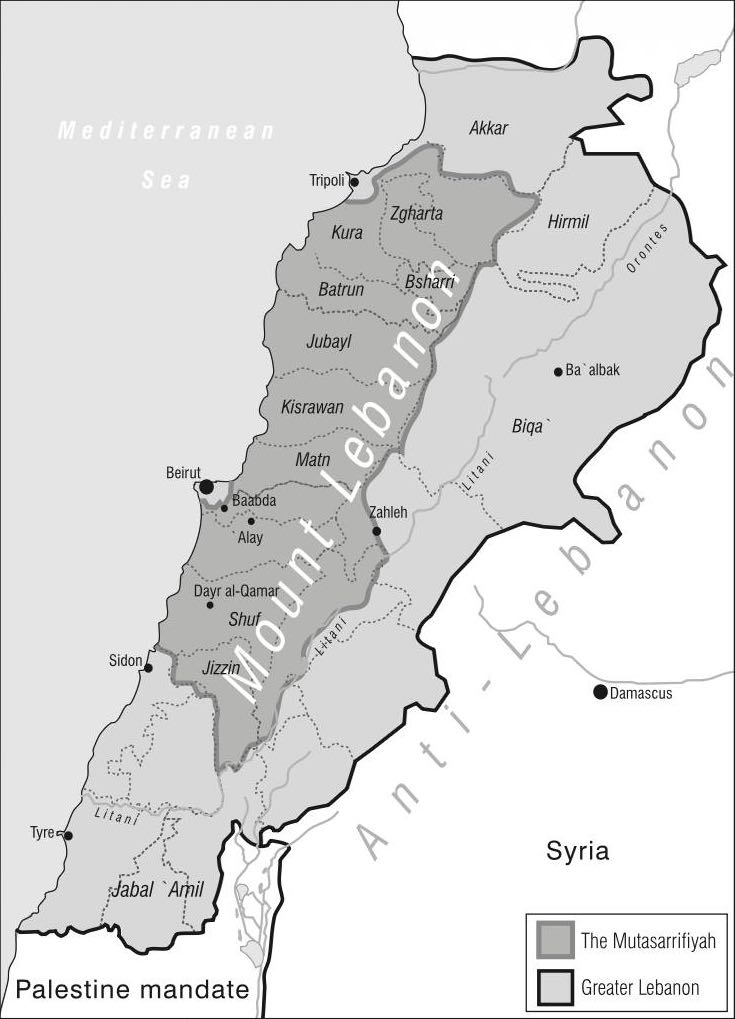
Lebanon was created as an expansion of Mount Lebanon via the annexation of the coastal cities—Akkar to the north, the Bekaa to the east, and Jabal Amel to the south.
The British Historian, Patrick Seale, summarizes thus:
“[Greater Lebanon] was intended as a haven for the predominant Maronite community, France’s main clients, but, in terms of geopolitics, it was also conceived as a French fortress in the eastern Mediterranean, which could be used against European rivals as well as against Arab nationalists of the Syrian interior.”8
This is the origin of the Lebanese entity. A Maronite Christian state built to advance the strategic interests of France in the region.
During this same period, another ethnostate was slowly being constructed south of Lebanon. But instead of allying with an existing local community, the British opted for settler colonialism, aiming to make European Zionists the dominant force in Palestine.
The contempt that these white, colonial Europeans felt towards Indigenous populations was clear not just in these actions but also in how they described what they were doing. For example, in response to objections to using the new technology of aerial bombardments against civilian populations, Lloyd George, the Prime Minister of the United Kingdom from 1916 to 1922, is reported to have said
“We must reserve the right to bomb ni**ers.”9
Those were the people who were now in charge of Mandatory Palestine. At that point, Zionist colonists had already been settling in Palestine for almost 40 years, though very slowly. With support of the British, that migration increased dramatically, and it soon became evident to the local Palestinian population that the British were giving favorable treatment to the new European Jewish communities.
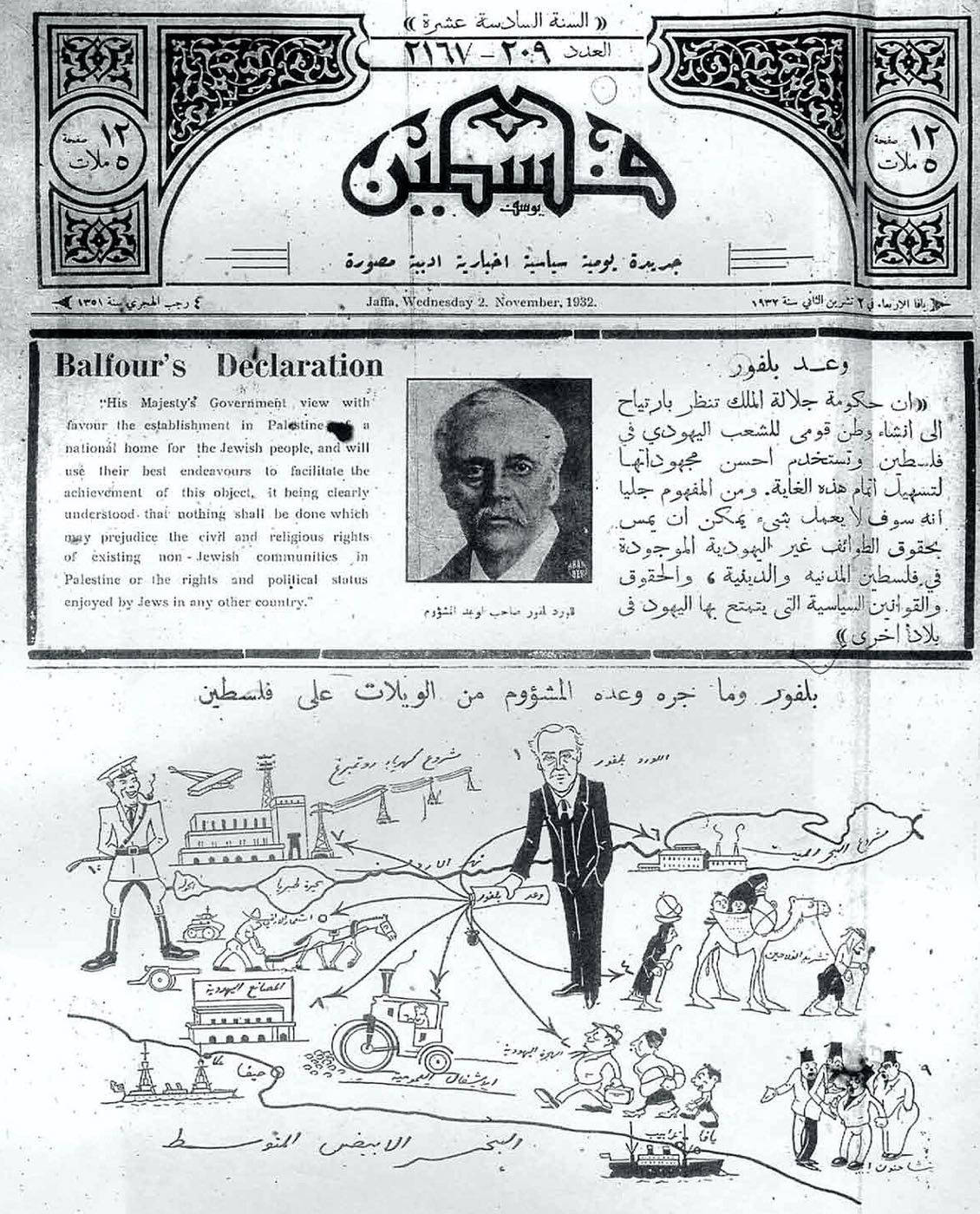
A newspaper cover from Palestine with a cartoon depicting Balfour supporting Jewish migration and industry in Palestine, as well as the disenfranchisement of local populations.
Examining maps from 1918 and 1920, we can see the beginnings of the conflict over the southern part of Lebanon. The first map broadly depicts the future state of Israel, as well as Palestine, Jordan, Lebanon, and parts of Syria, without any defined borders whatsoever.
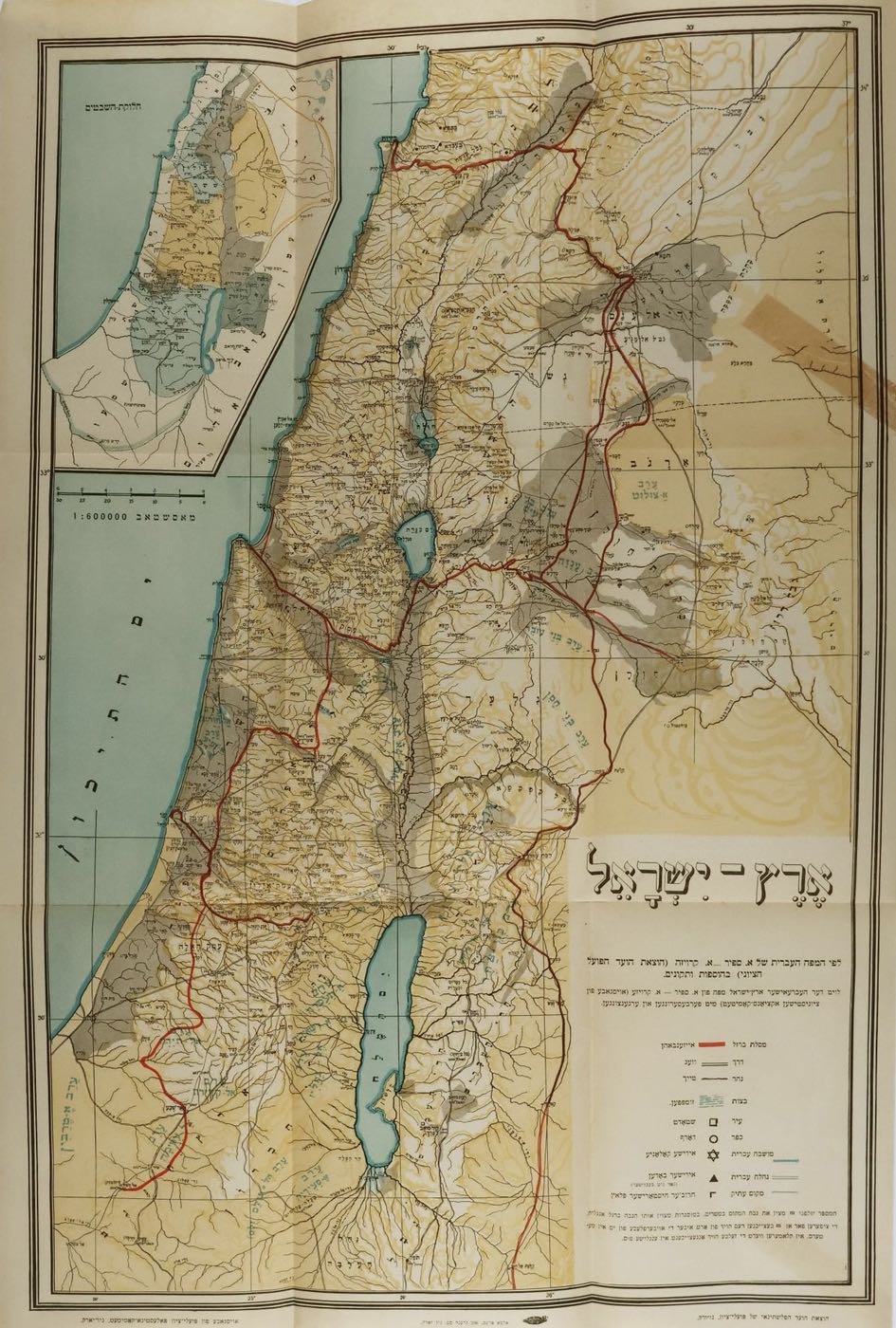
A map from 1918. Those red lines are actually train lines; there are no borders on this map. Though hundreds of miles of railway once ran through Lebanon, they were rendered inoperable by the Lebanese Civil War. The last trains ceased running in the 1990s.
The map from 1920 shows three lines that could define the northern border of the future state of Israel. The first is the Sykes-Picot line; the second is the “suggested” border, extending into Southern Lebanon; the third represents a “Maximum Demand” border engulfing all the territory up to and including the Litani River.
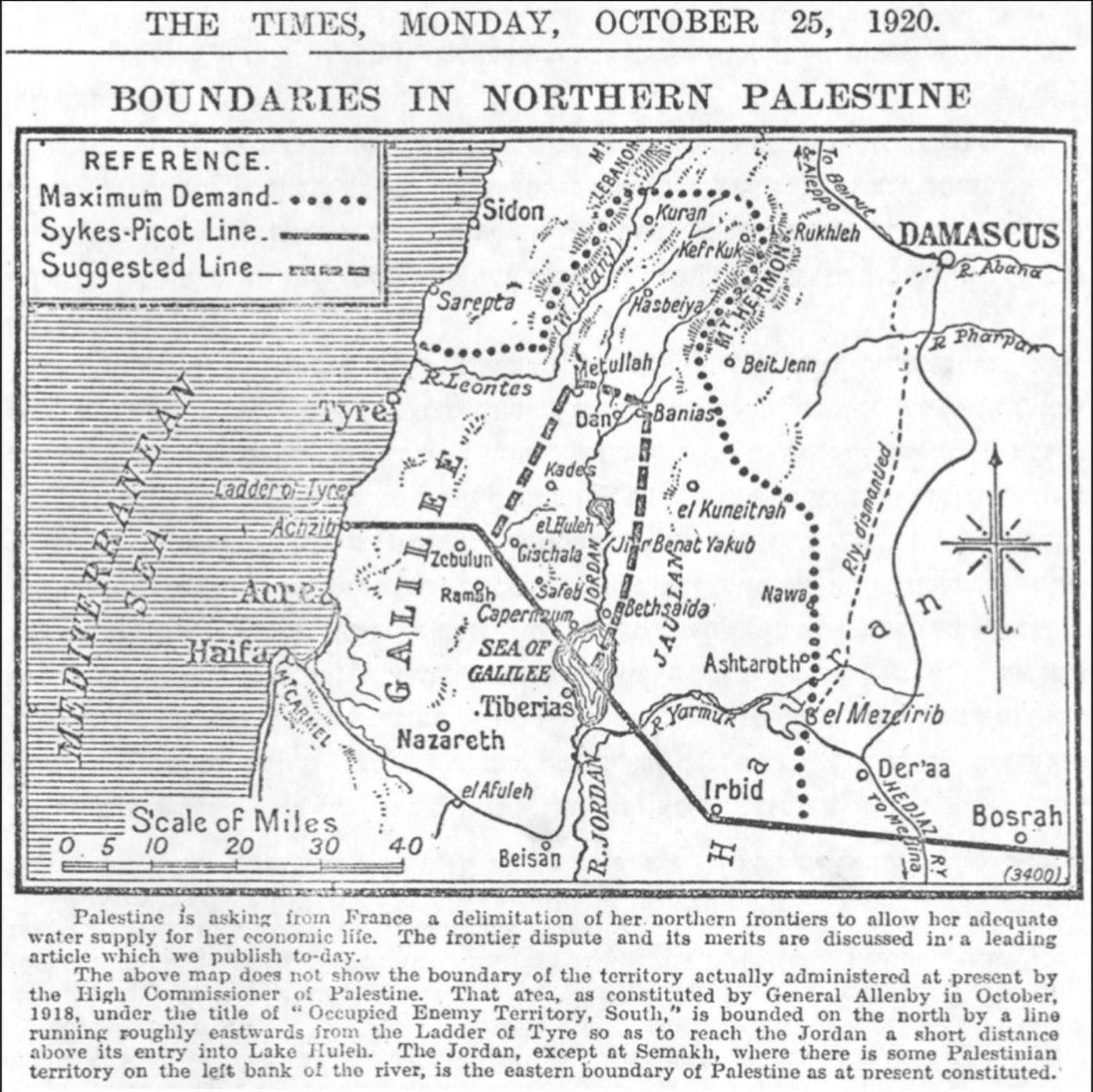
A map from 1920.
Sykes-Picot wasn’t the final agreement between the French and the British. In 1923, the two powers drafted a more detailed accord, the Paulete-Newcombe agreement, defining the borders between Mandatory Lebanon and Palestine more precisely. This agreement moved the borders, placing several Lebanese villages under the authority of the British Mandate. Britain took over about 20 Lebanese villages—including Malakiyya, Saliha, and Hunin, all of which were inhabited by Shia Muslims.
Over the next twenty years, the colonization of Bilad al-Sham met ongoing resistance. The largest effort to oppose the colonial process during this period was the Great Palestinian Revolt of 1936-1939. The British, alongside Jewish settler militias such as the Haganah, employed a tremendous amount of violence to crush the revolt. Yet the rebellion was so powerful that in order to crush it, the British stationed more troops in Palestine than they had in the entire Indian subcontinent.10 Afterwards, they expelled its surviving leaders to neighboring countries.
War gripped the region over the following years; it was one of the theatres in which the European powers contended in the Second World War. Lebanon was one of the few places where the British and French fought each other directly. During this period, Allied Forces armed and trained Jewish militiamen like Moshe Dayan; this ultimately left them far better equipped than the national armies in the region.11
In the midst of the war, in 1943, after the Vichy Government was defeated in Lebanon, Lebanese elites declared independence from France. But it wasn’t a bitter breakup; they maintained a very friendly relationship with their former colonizers.
Just after the end of the Second World War, Zionist militias stepped up their own campaign for independence in Palestine. They did so by carrying out terrorist attacks against the British, most notably the 1946 King David Hotel bombing.12 By May 1948, when the British Mandate of Palestine was set to expire, the British were eager to wash their hands of the conflict they had been instrumental in creating.
This led to what Arabs call the Nakba, the Catastrophe. Hundreds of thousands of Palestinians were expelled from Palestine, with at least 100,000 heading to Lebanon. The villages mentioned above—Malakiya, Saliha, and Hunin—were among the destroyed villages whose entire populations were expelled into Lebanon.
Lebanon participated very little in the war that ensued, known as the first Arab-Israeli war. In most locations, even within Lebanese territory, the Lebanese army withdrew, refusing to fight the Zionists. The only town that saw the Lebanese army resist was Malakiya, a Lebanese village with a predominantly Shia population that had been turned over to British Occupied Palestine. The Lebanese army successfully fended off assault after assault in Malakiya, lost the town, recaptured it, and thereby demonstrated that fighting back was possible. In the end, the Lebanese army only withdrew from Malakiya after intense international pressure.13 An Israeli kibbutz has stood in its place ever since.
The Shia Lebanese inhabitants of Malakiyya, like those of the other permanently cleansed villages, became refugees in Lebanon. In fact, they had the same legal status as Palestinians in Lebanon until the 1990s. To both the Zionists who perpetrated the Nakba and the bureaucrats of the Lebanese entity, the Shia of Jabal Amel were no different from the Palestinians.
Zionist forces also carried out attacks in Southern Lebanon, notably during Operation Hiram. Not only did they invade the country, they also committed numerous massacres against Lebanese civilians, such as the Hula massacre in November 1948, in which they killed approximately 60 civilians. Their forces reached deep into Lebanese territory, as far as the Litani river. Finally, in 1949, Lebanon agreed to an armistice with the state of Israel, which brings us to our first ceasefire.
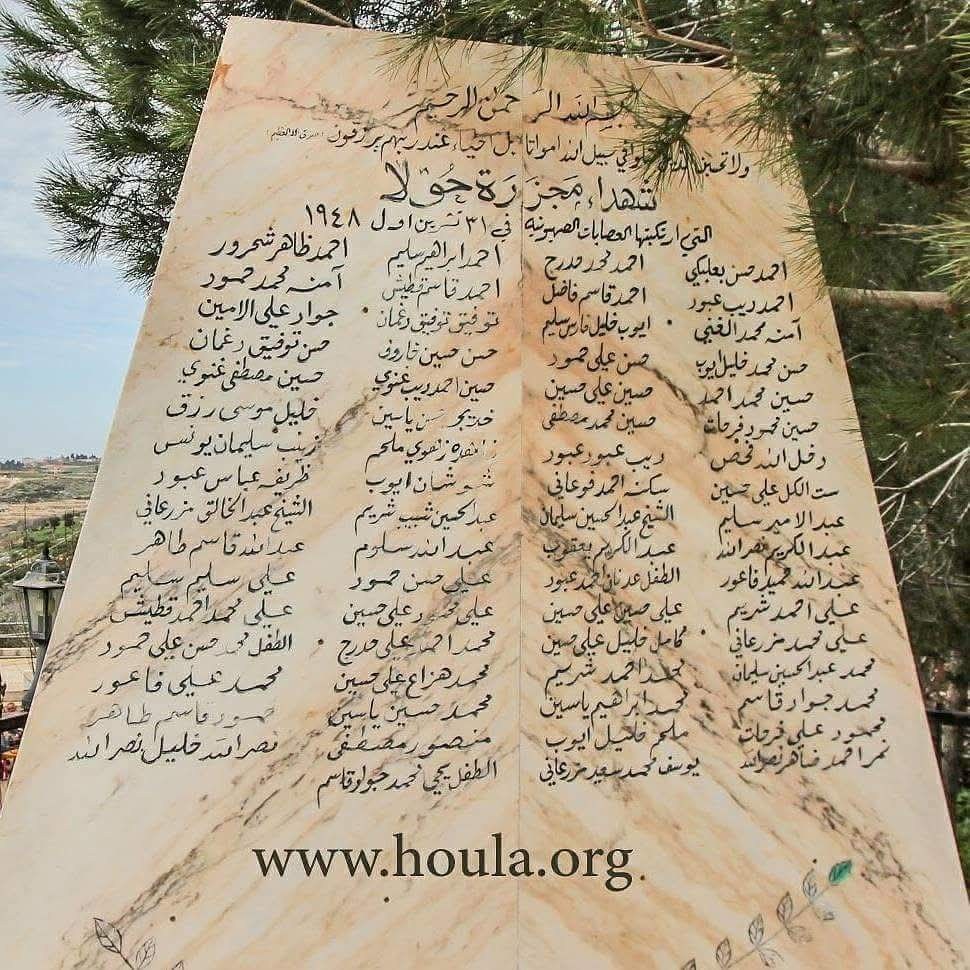
A memorial in the Southern town of Hula with the names of all the martyrs of the Hula Massacre.
The state that was founded through this ethnic cleansing, known to many as the Zionist entity, went on to be an expansionist, ethnonationalist, armed garrison state. This is clear to a lot of people today. But not as many people understand the nature of the state of Lebanon.
The defining feature of the Lebanese entity is the political system of sectarianism. In 1943, the ruling Christian Maronite and Sunni elite drafted the National Pact, stipulating that Lebanon should have a Maronite Christian President, a Sunni Prime Minister, and a Shia speaker of the house—an agreement that remains to this day. At the time, the President had tremendous executive power and the Speaker of the House was largely symbolic. Other posts in the government were likewise divided up along sectarian lines, with a majority going to Christian Maronites.
It is a mistake to imagine that Lebanon has this sectarian system because of its many religious communities. The sectarian system is not simply an organic expression of the sectarian divisions in the country. It is a system that enabled the local elite from the main sects, with the Maronite elite on top, to become mediators between the colonial powers and the local populations. The Lebanese Marxist intellectual Mehdi Amel offers a concise description of this system:
“Sectarianism is the particular historical form of the political system through which the Lebanese colonial bourgeoisie exercises its class dominance within a relation of structural dependency on imperialism.”14
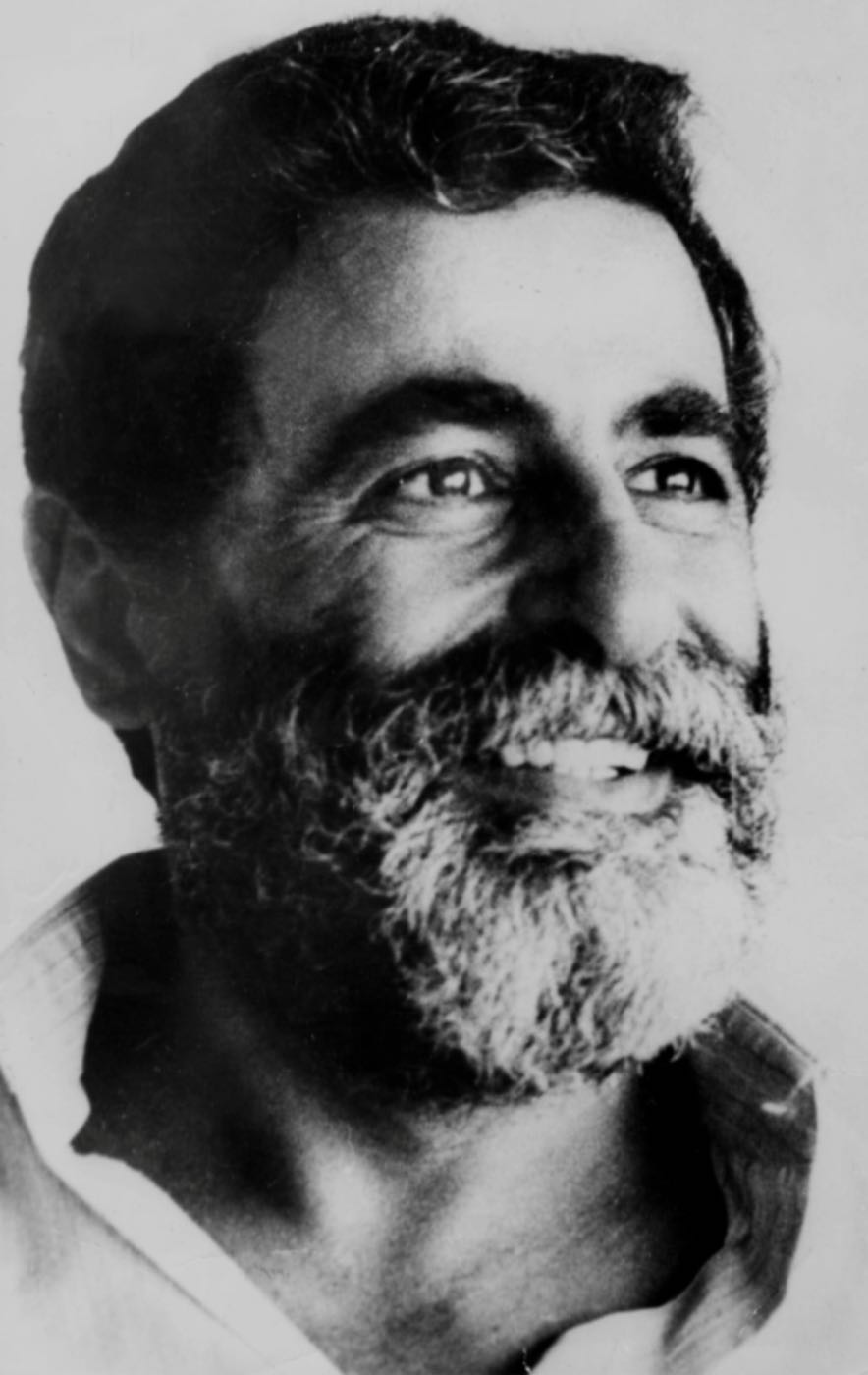
Mehdi Amel, Lebanese Marxist intellectual, 1936-1987.
That might sound like Marxist word soup, but in fact, it is incredibly precise. This system means that different posts in the Lebanese state are divided among the sectarian elite—whether Christian or Muslim—with a disproportionate number of those positions going to Maronite Christians. That elite politics offered continued access to European finance, which came to form the backbone of Lebanon’s economy to the detriment of local productive economic activities like industry and agriculture.15
At the level of everyday life, it means that, as citizens, we only exist to the state as members of one sect or another. When I vote in elections, I have to go to my father’s village, and I can only vote for Druze or Christian candidates, because they are the main inhabitants of my area. I don’t exist as a citizen, as an individual, but as a Druze from a specific area. This is somewhat similar to the current system in the state of Israel, where universal citizenship does not exist and the state reduces people to their ethnicity. Ultimately, this system disenfranchises the vast majority of people; it is not even representative.
The sectarian system in Lebanon went through several crises in the 1950s and 1960s. But the greatest threat to its existence emerged a decade later: the Lebanese National Movement of the 1970s.
We can divide the chief obstacles to the fulfilment of the sectarian system into three distinct aspects of Lebanese society. First, the existence in Lebanon of an entire sect, comprised predominantly of agricultural communities in the South and East, that had practically no representation within the sectarian or oligarchic system: the Shia. Located mostly in the South of Lebanon, in a region known as Jabal Amel, these communities also suffered an economic blow following the creation of the state of Israel, as their economy relied heavily on trade.
Second, the real divisions between people were not based on sect, or religion, but on class—and the sectarian elite had no serious plan to deal with the contradictions of colonial or capitalist class divisions, let alone the feudal divisions that still existed.
Mehdi Amel summarizes these first two issues in the same text quoted above:
“The foremost obstacle was the mass of toilers who belong to the downtrodden ‘sects’ and live either in the countryside or in the clutches of poverty in the capital. As their voices were raised, so did their acts of resistance. They demanded the system be changed, whether by putting an end to sectarian hegemony without destroying the system itself, or by putting an end to the system entirely.”16
And the third major obstacle to the system was the introduction to Lebanon of over 100,000 Palestinian refugees who had been forcibly expelled from their country, most of whom were Sunni Muslim. Not only did this mess up the carefully arranged demographic balance within the country, it also forced Lebanon to reckon with the fact that it is not an island separate from the rest of the region.
Almost immediately after their expulsion, unorganized Palestinian Fedayeen militants began carrying out operations against the nascent state built on the ruins of their homeland. Palestinian refugees also tried to return to their homes.17 In Lebanon, the army moved quickly to block these attacks and returnees, fearing Israeli reprisals. They did this by placing Palestinian refugee camps under what amounts to martial law, controlling movement and political activity.
This was the context in which Moshe Dayan made the statement quoted above about annexing Lebanon up to the Litani river to put an end to these cross-border raids by Palestinian militants. In the end, they didn’t have to do that, as the Lebanese armies proved quite effective in suppressing Palestinian efforts.
At the same time, Israel was occupied in conflicts with Egypt, Syria, and the Palestinian territories they had failed to capture in 1948.
A few key events led to the Israelis focusing more on Lebanon. The first was the Palestinian Revolution of 1965, which saw the creation of Fatah, the first serious attempt for Palestinians in exile to unify and organize around armed struggle. The largest organization was the Palestine Liberation Organization, which was mostly based in Jordan at that time but had a strong presence in Lebanon too.
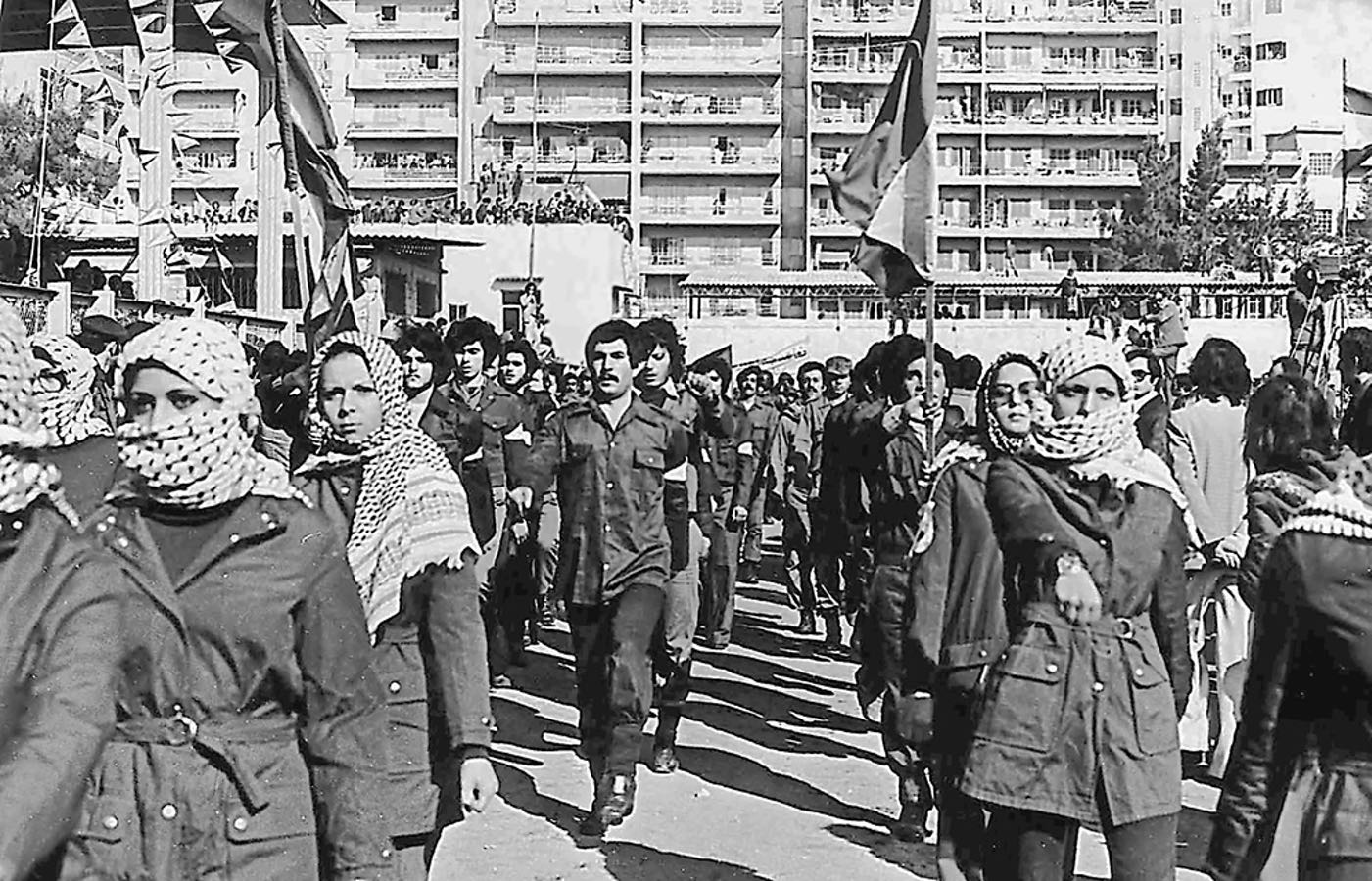
A rally involving Palestinian fedayeen militants circa 1965.
The next major development was the defeat of the Arab armies in 1967, and with it, the crushing of the hope that Arab nationalist regimes would liberate Palestine. Then, in 1970, Black September in Jordan saw the Jordanian army wage a war against Palestinian militants and expel them to Lebanon. That was when Israel really turned its focus to Lebanon. Wanting to quell assaults from the north, the Israelis begin implementing a multi-pronged strategy.
First, they attacked targets in the areas from which they suspected that assaults might emerge. This went hand in hand with indiscriminate bombing campaigns that did not differentiate between civilian and military targets.
Second, Israel intentionally carried out attacks on civilians in order to try to turn them against Palestinian militant groups. For instance, in 1974, the United Nations brokered a ceasefire called the “Olive Truce” in hopes of enabling Lebanese farmers to harvest their olives. Israel violated it after just three days, carrying out ground raids and aerial bombardments.18
Moshe Dayan had summed up this policy of collective punishment in the 1950s:
“We could not prevent every murder of a worker in an orchard or a family in their beds. But it was in our power to set a high price for our blood, a price too high for the Arab community, the Arab army, or the Arab governments to think it worth paying… It was in our power to cause the Arab governments to renounce ‘the policy of strength’ toward Israel by turning it into a demonstration of weakness.”19
And the third strategy that the Israelis implemented in Lebanon was to court Lebanese Maronite collaborators—both in Southern Lebanon and in Beirut. Already in the early 1970s, the Israelis were arming the Phalange, or Kataeb, a far-right Maronite party founded by Pierre Gemayel in 1936 in the image of the Nazi party in Germany.20
In response to these conditions and contradictions, in 1969, leftists in Lebanon formed what became known as the Lebanese National Movement. This proved to be the greatest threat to the sectarian system to date. The Lebanese National Movement was an explicitly anti-sectarian, pluralistic movement with strong socialist currents; it was allied with the PLO. They understood that the Lebanese struggle against the sectarian oligarchal system had to be connected with the struggle for Palestinian liberation against Zionism.21
The Maronite elite, organized mostly within the Kataeb Party, hated all of this because they had a lot to lose. They blocked any change to the system. The first efforts to change it took the form of political maneuvers; when those failed, armed struggle erupted. This was the backdrop of the civil war in Lebanon, which ignited in 1975. As future president Amin Gemayel put it,
“We have tried to save institutions from any change. Although violence leads nowhere, it has helped us at least to save what could be saved. It was violence to conserve the system.”22
For its part, Israel had already been supporting the Phalange for years, hosting meetings with their leaders, training their soldiers, and sending them weapons. They preferred the continued domination of the Maronite Christian elite to anything else: not only because of their mutual antagonism to the Palestinians, but also because in many ways, the sectarian system that elevated the Maronite elite to power mirrored their ethnonationalist system more than the pluralistic, leftist, and pro-Palestinian tendencies represented by the Lebanese National Movement.
When war broke out in Lebanon in 1975 while all other fronts functionally closed, Israel turned its full attention to Lebanon. They continued to fund the Kataeb, even though—or because—the Kataeb were massacring Palestinians. In 1976, Israel created what they called the “Good Frontier” in Southern Lebanon as a buffer zone.23 There, they installed Saad Haddad, an officer who defected from the Lebanese army to serve as Israel’s viceroy in South Lebanon. In this collaboration with Saad Haddad, the Israelis could finally fulfill the fantasy that Moshe Dayan had described twenty years earlier.
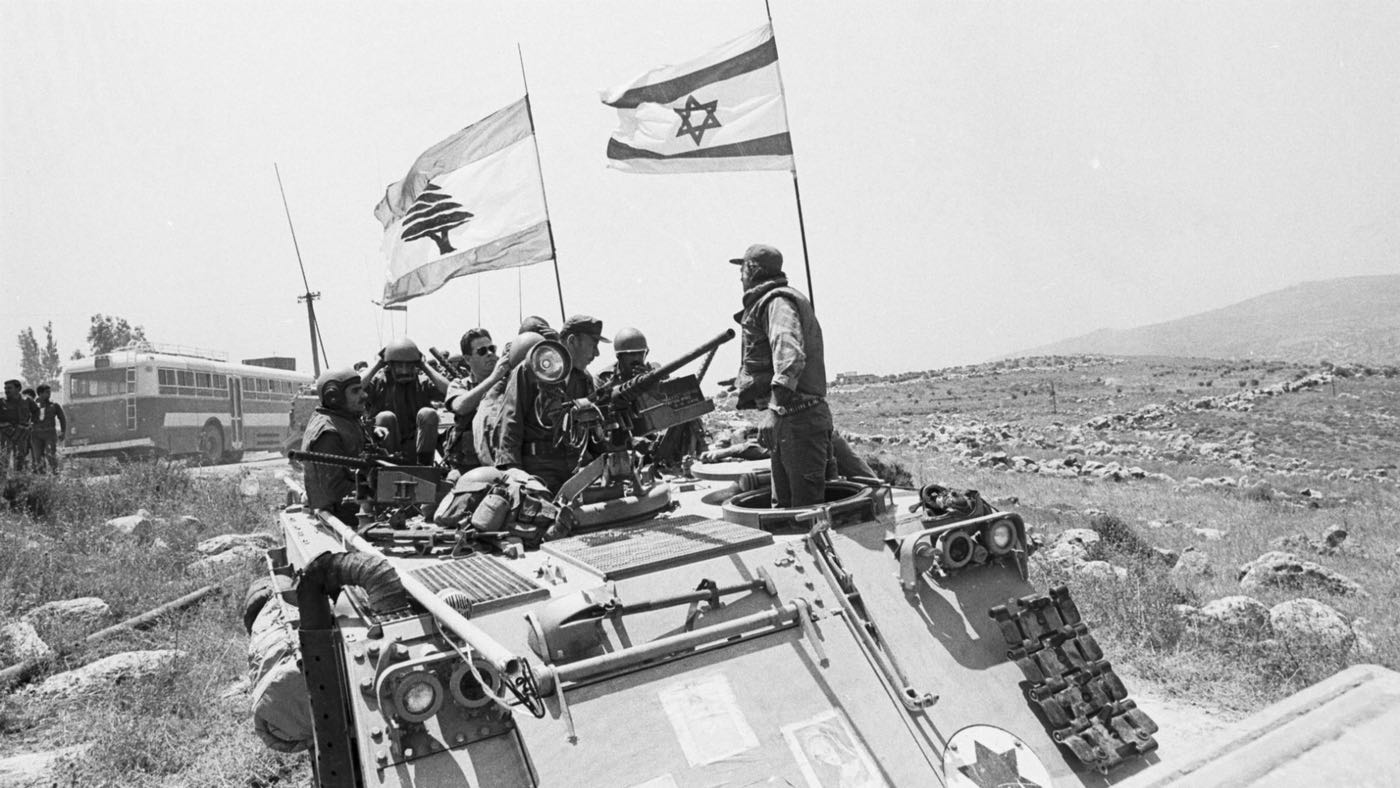
The collaborator Saad Haddad on a tank in Southern Lebanon with Lebanese and Israeli flags.
Three years into the war, in 1978, Israel invaded Lebanon in what they called Operation Litani. The Foreign Minister of Israel at the time was Moshe Dayan himself. Many people think of this as the beginning of the Israeli occupation of southern Lebanon—a period that saw Haddad’s forces commit numerous massacres in the South and solidify his hold in this newly-created buffer zone.24 But Israel’s presence in the rest of the country was short-lived. On October 10, the United States, then under Jimmy Carter, forced a ceasefire deal on Israel, which withdrew. Yet the occupation of the South continued, and so did the resistance against it.
That ceasefire played out exactly like the ones we’ve seen more recently. Israel continued bombarding Southern Lebanon and arming their fascist Maronite Christian proxies across the country, while both the Lebanese people and the PLO acted with restraint. Eventually, this became unsustainable. On July 15, 1981, the PLO finally began firing rockets into Israel; Israel responded by carpet-bombing populated areas in the south, attacking Tyre’s port, and setting fire to an oil refinery.
On July 24, the US brokered another ceasefire. Again, the PLO abided by it, while Israel violated it repeatedly. Then, on June 6, 1982, when the ceasefire had been in place for almost a year, the Israeli military invaded Lebanon. This time, their excuse was an assassination attempt targeting the Israeli ambassador to the UK, even though the group behind the attempt was openly opposed to the PLO. In fact, Israeli Defense Minister Ariel Sharon had already been planning the invasion for months.25
The 1982 invasion took place on a much larger scale than previous Israeli assaults. It was the first time they crossed the Litani River. The Israelis besieged Beirut and, after bombarding the city and cutting off electricity and water, managed to force a ceasefire on the PLO.26 As part of that ceasefire, the PLO agreed to evacuate Beirut, fulfilling the primary stated aim of the Israeli invasion. But the Israelis didn’t withdraw, because another aim of the invasion was to ensure the election of Bashir Gemayel, the head of the Kataeb Party, as president of Lebanon.
On August 23, with Israeli tanks in the streets, Bashir Gemayel was elected president, a terrifying prospect for the Palestinians and the Lebanese left. Two weeks later, Gemayel was assassinated in a car bombing outside his headquarters. The assassin was later identified as a Lebanese Maronite, Habib Shartouni, a member of the Syrian Socialist Nationalist Party.
Nonetheless, many who were loyal to Gemayel quickly blamed Palestinians. Christian fascist militias under the protection of the Israelis committed the most notorious massacre of the war, the Sabra and Shatila massacre, in which the Israelis aided their Christian allies in killing over 2000 Palestinian and Lebanese civilians.
Following this horrific massacre, resistance against the Israeli occupation increased dramatically. Alongside other pressures, this compelled Israel to withdraw from Beirut in September 1982. This was the first time an Arab capital liberated itself from Israeli occupation through armed struggle.
During this period, the Americans created the Multi-National Force, which entered to enforce the ceasefire between the PLO and Israel. In September 1983, the US sent 2000 marines into Lebanon to ensure the success of the Lebanese government under Bashir’s brother, Amine Gemayel.
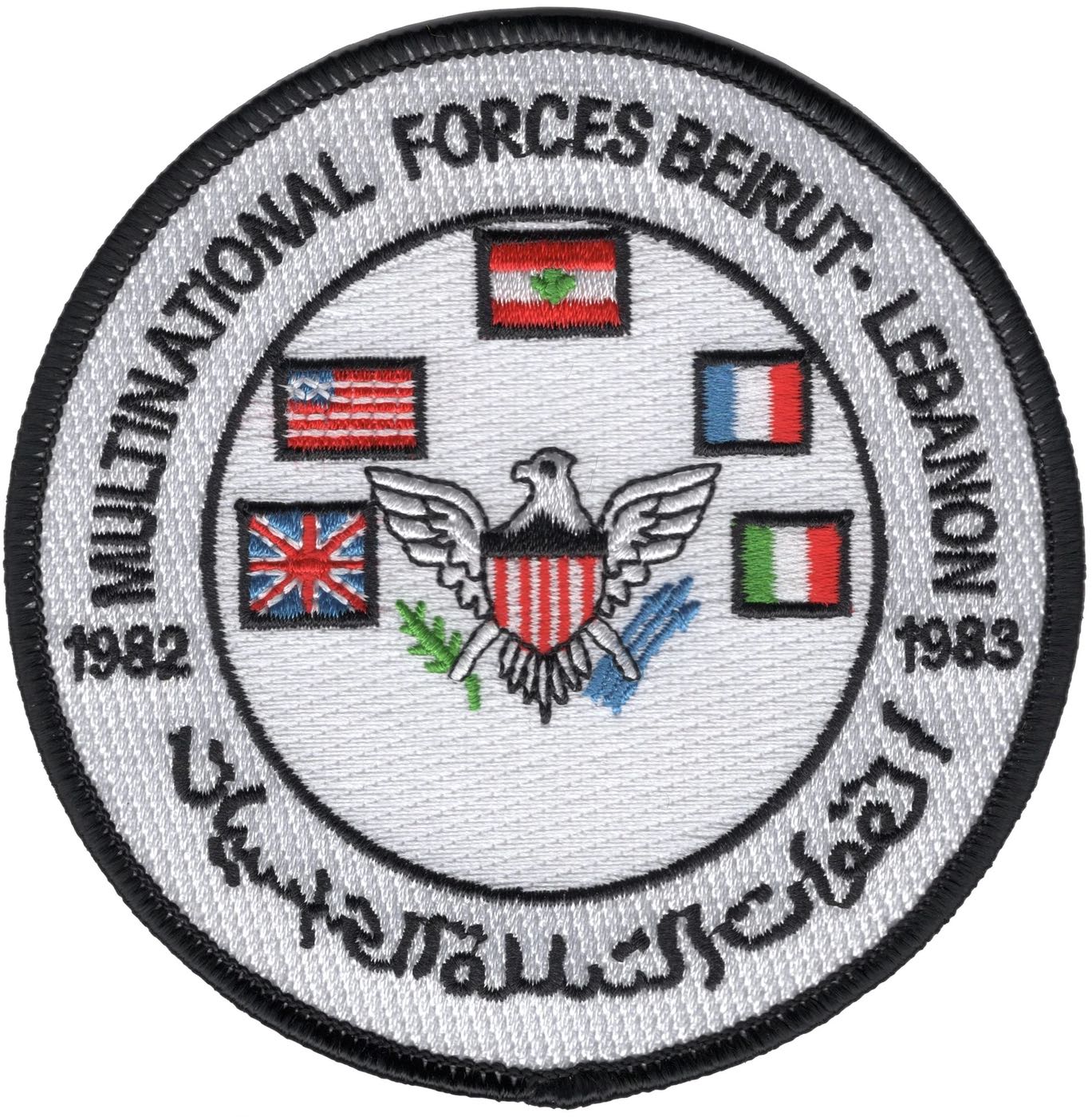
A badge of the Multinational Force in Lebanon (MNF) with flags of all the participating powers.
On October 23, 1983, two truck bombs targeting the headquarters of the US marines and the French battalion center inflicted many casualties. The former was the single largest loss of life for American marine forces since the Battle of Iwo Jima during the Second World War. The attack was claimed by a group nobody had heard of at the time, which later revealed itself as Hezbollah, the party of God.27 The US and the rest of the Multi-National Force were forced to leave Lebanon the following year, in large part because of these attacks.
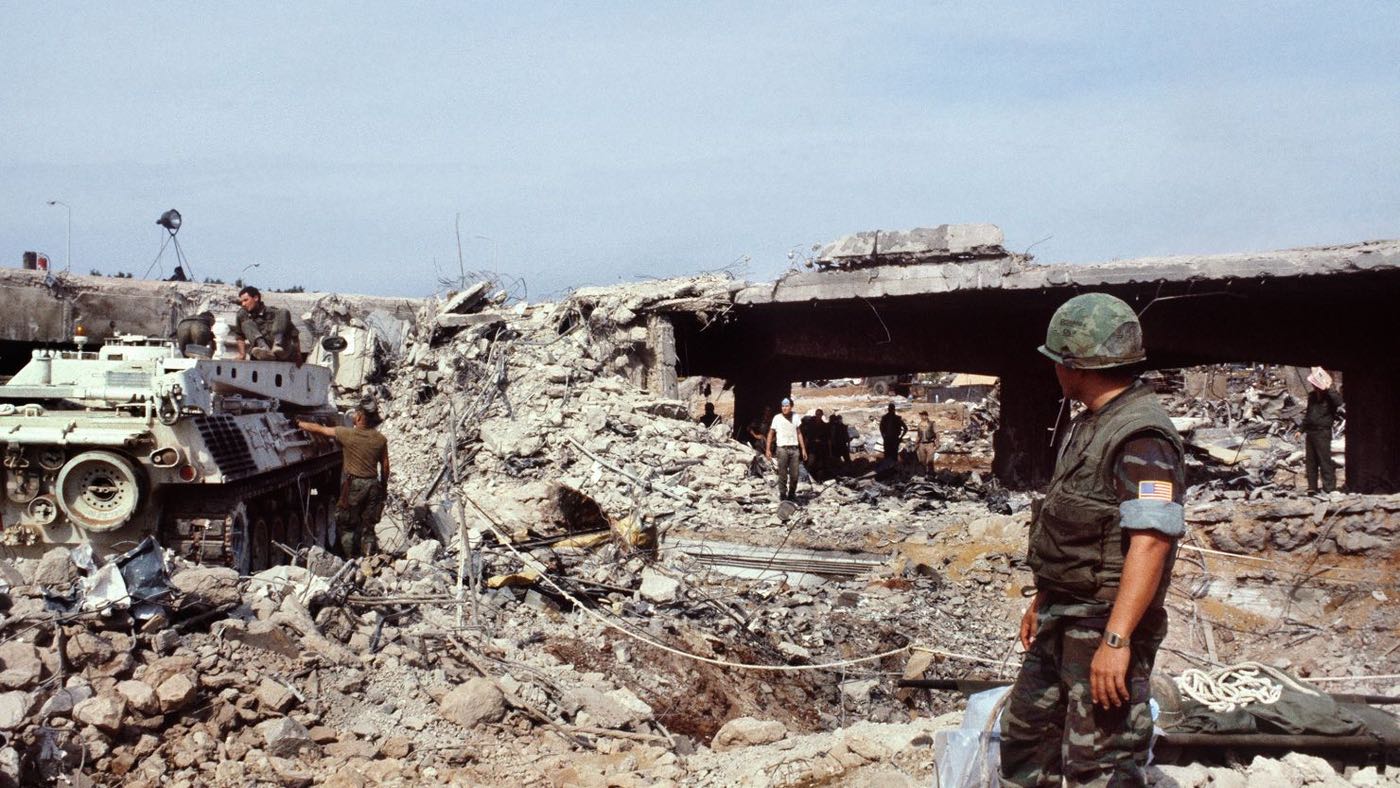
The aftermath of the bombing of US marine barracks in Beirut, 1983.
In 1985, Israel “withdrew” from Lebanon; in reality, the buffer zone in the South remained, where Israeli soldiers and settlers could move freely. This continuing occupation led to the rise of Hezbollah, whose guerilla fighters carried out attacks targeting Israeli troops and their proxy militia.
Israel’s first major attempt to crush this resistance took place in 1993, when they unsuccessfully attempted to push them north of the Litani river. They attempted the same thing with a 17-day assault in 1996, “Operation Grapes of Wrath.”
The Lebanese civil war went through many phases, ending in 1990 with the signing of the Taif Accord. But the core issues that ignited the war were never addressed, nor the issues that arose during the fifteen years of fighting. What started as a demand to end the sectarian system descended into sectarian chaos, and was ultimately resolved with some shifting of sectarian quotas and power divisions among the sectarian elite. The chief losers of the war, the Palestinians, were blamed for the war and lost almost all of their political and military presence in the country.
The occupation of the south ended in 2000, after the resistance forces that emerged in response to that occupation—most notably Hezbollah—made it untenable. But one territory became a major sticking point, the Occupied Shebaa Farms, which the Israelis captured from Syria in 1967. Hezbollah claimed that this territory was Lebanese, arguing that the Israeli withdrawal remained incomplete.28 Others saw this as an effort to continue to validate Hezbollah’s existence as an armed resistance group after the withdrawal of occupation forces.
Thus began a six-year low-level cross-border conflict, culminating in the 2006 July War. Israel once again invaded Lebanon, destroying infrastructure including oil depots, vital bridges, and the country’s only international airport. They were demanding the demilitarization of the entire region south of the Litani river. The conflict ended with a ceasefire deal brokered by the UN, stipulating that UNIFIL forces should expand their deployment as far as the Litani river.
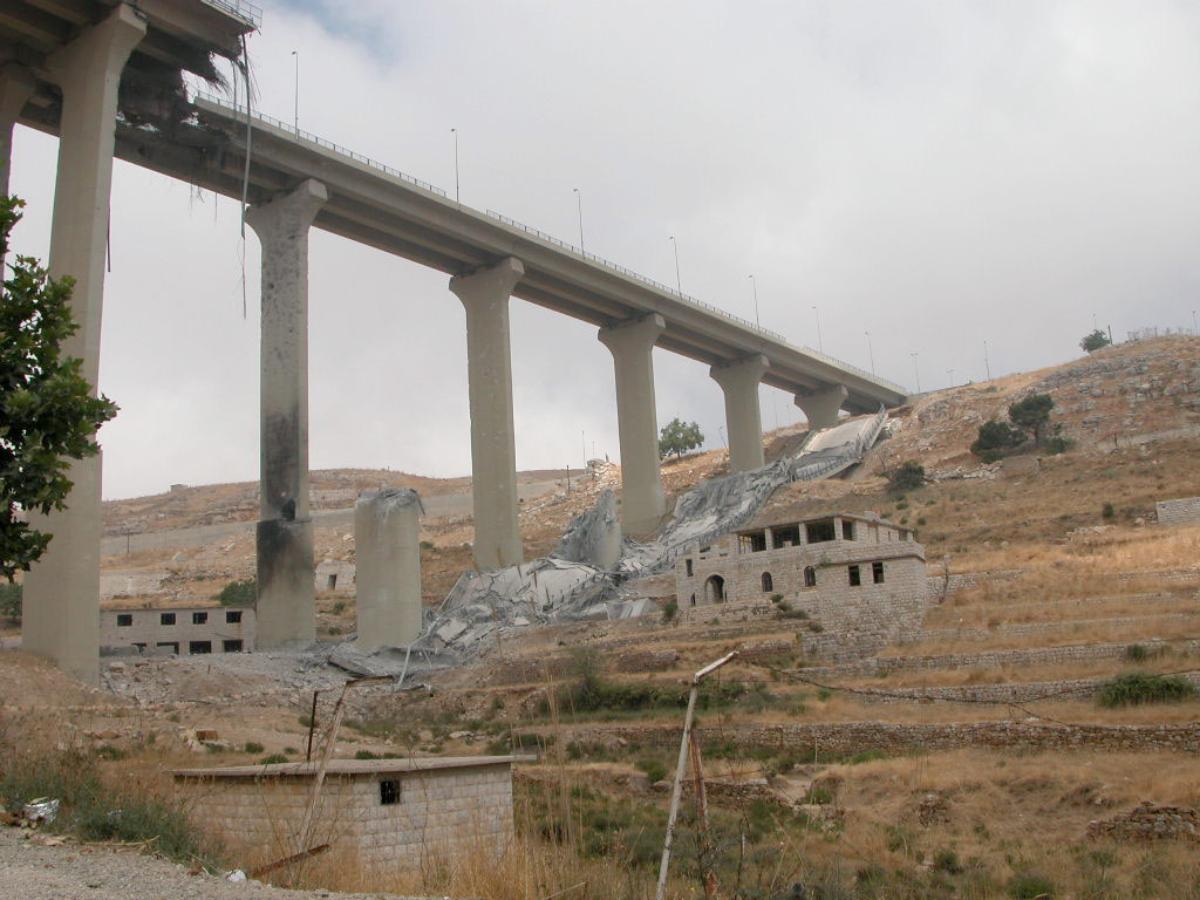
The destruction of a bridge in Lebanon by Israeli airstrikes in 2006.
The intervening period saw a relative calm between Lebanon and the state of Israel, with few clashes and attacks. At the same time, Israeli jets, reconnaissance planes, and later drones flew over our heads continuously. Between 2007 and 2022, Israel violated Lebanon’s airspace over 22,000 times—about four flights a day.
This was also a period of uprisings and violence in Palestine, specifically in Gaza. After the election of Hamas in 2006, Israel blockaded Gaza. Every few years, the Israelis bombarded Gaza—what they called “mowing the lawn.” Israeli settlements in the West Bank expanded throughout this period. Israelis focused on consolidating hegemony over the territories they had occupied since 1967 while making threats against Hezbollah and Lebanon.
For their part, Hezbollah expanded from simply being an armed resistance group to become a player in the Lebanese political scene and regional affairs—for example, getting involved in the Syrian Civil War.
That was the climate leading up to 2023. Three years after the United Nations declared that Gaza was on the way to becoming uninhabitable, Hamas’s armed wing carried out the October 7 attacks, igniting the regional war that continues today. Hezbollah responded the following day by opening up what they called the Support Front, firing rockets into northern Israel.
This fighting simmered until September 2024, when Israel dramatically escalated its attacks on Lebanon, beginning with the notorious pager massacre. In the weeks that followed, Israel displaced over a million people, massacred civilians, killed much of Hezbollah’s top leadership, and targeted weapons depots belonging to the group. On September 30, they invaded Lebanon, again with the claimed intention of pushing Hezbollah back behind the Litani River. On November 27, they reached a ceasefire agreement stipulating that Hezbollah will disarm below the Litani River and tasking the Lebanese government with overseeing this. Israel remained in five positions in the South, claiming that it would withdraw if Lebanon fulfilled its obligations.
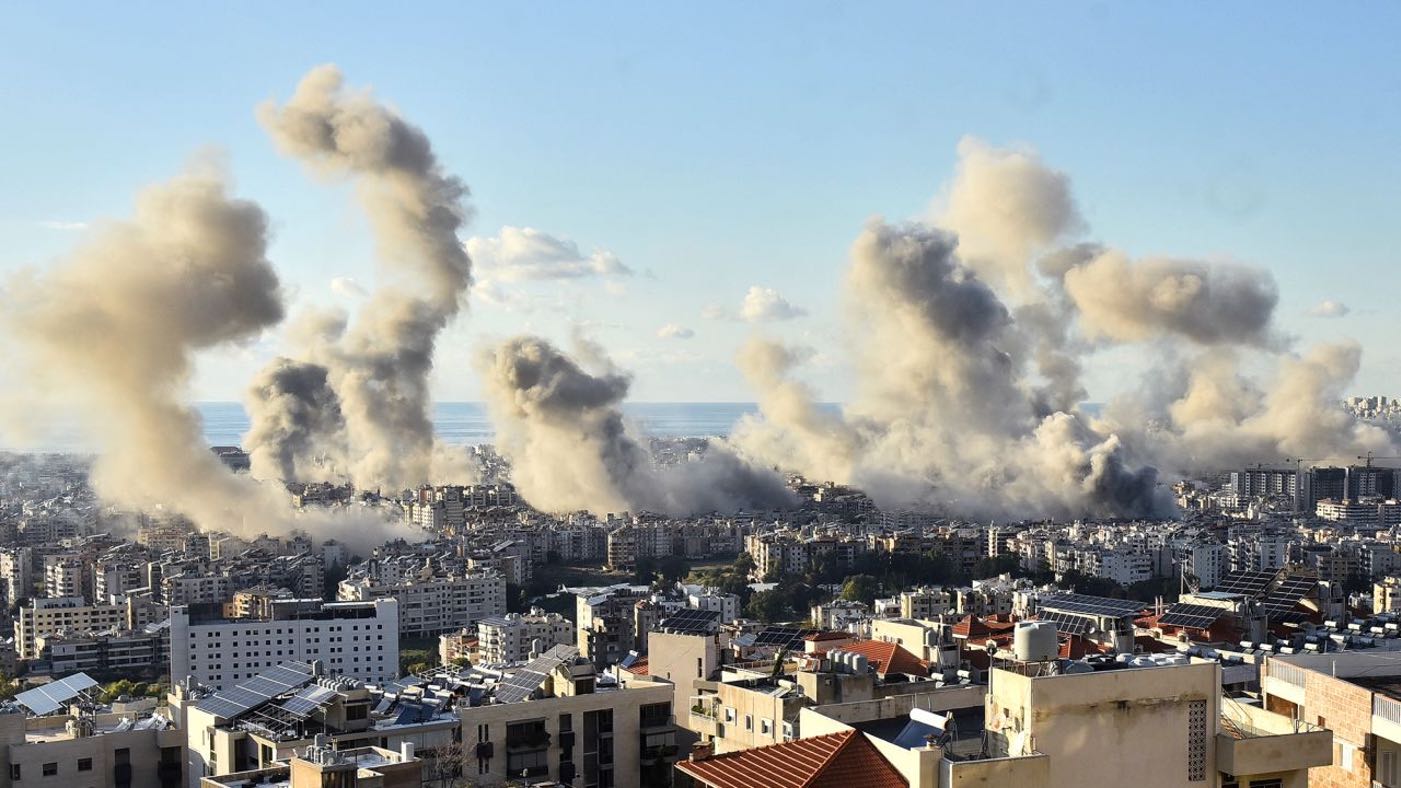
The destruction of homes by Israeli attacks, 2024.
During this ceasefire, the UN estimates that the Israelis violated the ceasefire over 10,000 times, while Hezbollah violated it once—a single time—in response to Israeli attacks. The Israeli violations included near-daily air strikes, assassinations, demolitions of homes, and ground raids.
Then, against the backdrop of the US/Israeli war on Iran, Hezbollah fired six rockets into Israel, precipitating the new escalation that we are witnessing today. There are many theories as to why they did this. Initially, Hezbollah claimed it was to avenge the killing of Ali Khamanei the previous day, and that it was a response to fifteen months of daily Israeli bombardment during the supposed ceasefire. Some suggest that the decision to resume bilateral hostilities offered a way for them to break out of the dynamic in which Israel treated Lebanon as a free-fire zone with zero deterrence from Hezbollah, the Lebanese state, or the so-called international community. Others argue that it was a reckless attempt to reclaim legitimacy after the defeats that Hezbollah suffered in 2024.
Regardless, we are here now. The Israelis are in Lebanon and they aim to stay. They want to create a “yellow line” in Southern Lebanon, yet another buffer zone. Many people see this as a land grab that could potentially establish permanent Israeli settlements there. Others believe that Israel is setting the stage for a massive resource grab—targeting not only the fertile agricultural area but also the waters of the Litani River. Based on the full-scale demolition of the villages they have captured, as well as the last two years of ecocide in the south—for example, Israel using white phosphorus munitions to poison the land—it is safe to say that the Israeli military is trying to fulfil the threat that Moshe Dayan made in 1974: “We will make all life impossible in South Lebanon.”
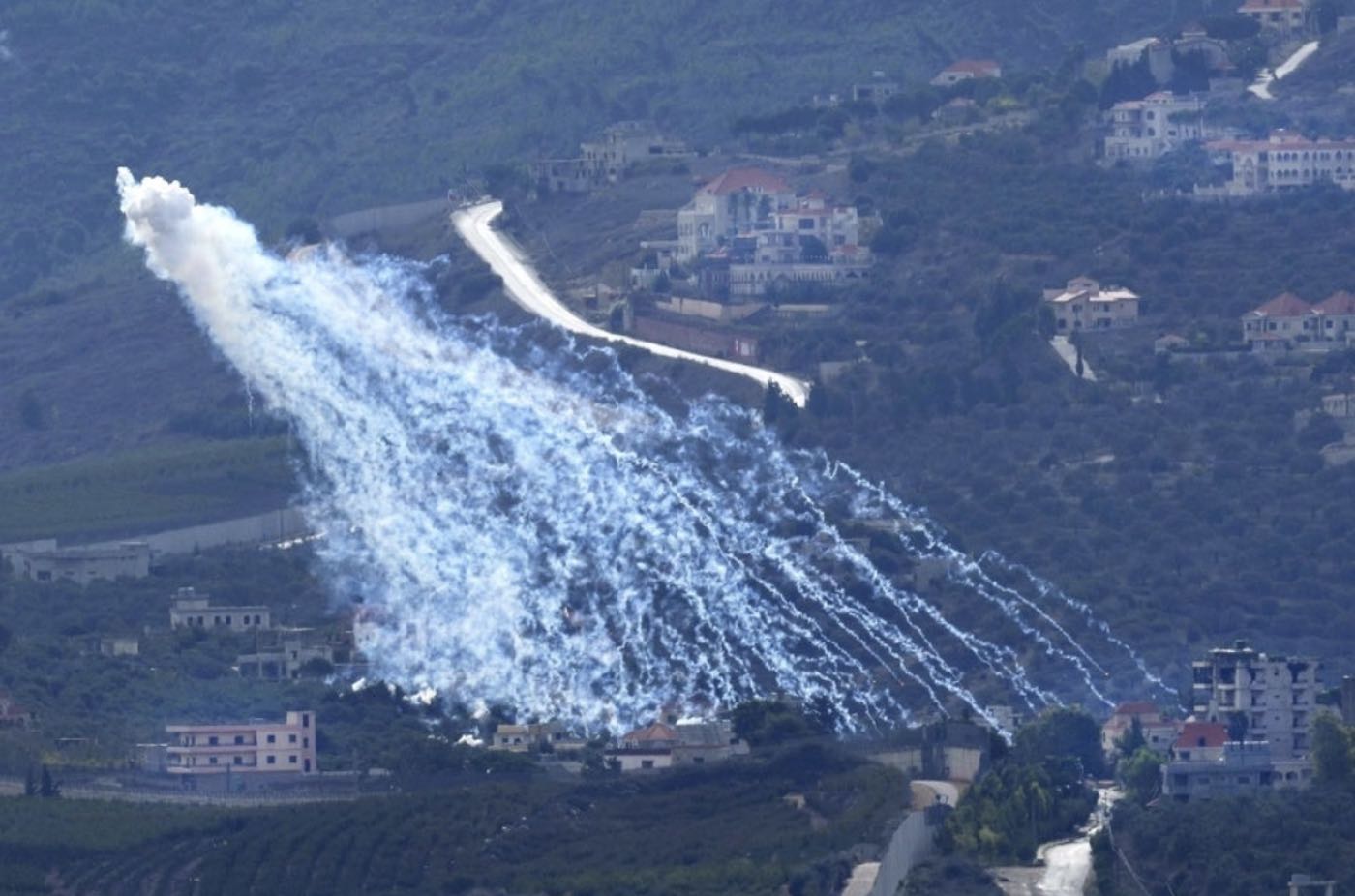
Israel has regularly used white phosphorus munitions in Southern Lebanon.
The Israelis are trying to ethnically cleanse the entire south. Although Lebanon and Israel agreed to a new ceasefire on April 16, the Israelis have not stopped their assaults. They are wantonly destroying whole villages, making sure that life is impossible, let alone return. This raises the prospect of a prolonged displacement crisis on top of the many other crises afflicting Lebanon at the moment. This is the familiar theme of Israel’s one-sided “ceasefires,” in Lebanon as in Gaza. For the Israelis, a ceasefire is a chance to recoup, plan, and establish new facts on the ground in the areas they’ve seized. They view this as a single, continuous war, now lasting the better part of a century.
Israel aims to destroy Lebanon. That will not change if Hezbollah disarms. The situation is pushing the country towards civil war, especially with the current government being so focused on disarming Hezbollah—both as an end in itself and in hopes of somehow deterring Israeli aggression. Civil war in Lebanon will advance Israel’s aim of fracturing and weakening the Lebanese state.
What are people in Lebanon supposed to do? What are the propositions on offer? Is there any feasible way to end Israeli assault and enable displaced Lebanese people to return to their homes in the south?
Between Resistance and Sovereignty
Lebanon is at a crossroads. Two camps are forming and neither is speaking to the other. One camp, led by President Joseph Aoun and Prime Minister Nawaf Salam, is pursuing direct negotiations with the Israelis. They have committed themselves to the goal of monopolizing arms in the hands of the state, while deferring anything to do with Israel to the so-called international community. The other camp, led predominantly by Hezbollah, is pursuing a course of armed struggle. Continuing on the path it set out over four decades years ago, its main strategy is continued reliance on the Islamic Republic of Iran and the military strategy of the so-called axis of resistance.
To the former camp, the sole problem is Hezbollah: supposedly, once Hezbollah is disarmed, Israel will stop bombing us and pull its troops out of the country. To the second camp, the only recourse is directly resisting the invading Israeli army and continuing the military confrontation with Israel. Each is accusing the other of treason for working on behalf of a foreign power.
Those critical of the current government accuse it of sacrificing Southern Lebanon for the sake of the rest of the country. Those critical of Hezbollah accuse them of sacrificing the rest of the country for the south. This division has a corresponding sectarian aspect as well. Added to the polycrisis in Lebanon, especially the grueling economic collapse which many claim to be one of the worst in a century, globally speaking, all of this is indeed a toxic recipe for civil war.
How do we stop Israel from bombing us? How do we get them out of Lebanon? How do we reign in the militant fascism and brazen expansionism that has become mainstream in Israeli society and politics? How do we protect ourselves from the growing imperialist mania of the US empire? Apart from arming Israel to the teeth, the US has not yet gotten involved in Lebanon directly—but if history is any indication, it very well might at some point.
It is difficult to answer these questions—not least because most of them have very little to do with us. Israel has become a deeply sick society, with poll after poll showing continued majority support for the genocide in Gaza, the war on Iran, the war on Lebanon. Settlers backed by the army are conducting wholesale pogroms in the West Bank. There seems to be no internal or international mechanism to stop their expansionist and genocidal ambitions.
I left Lebanon in 2021. I left for many reasons, but the one that made remaining there unsustainable was that I saw this war coming. I was constantly terrified by the sound of Israeli warplanes overhead. I could see the growing fascism in Israeli society for what it was—a lust for domination and expansion. Israel has never declared its borders, and it’s been clear for a long time that they want to take over Gaza and the West Bank. Then what? Will they start demilitarizing their society? No. The dominant force in Israel, both politically and socially, is the need for an external enemy so they do not turn on each other. This is a recipe for violent expansionism with no internal brakes. Today, the fire that the Israelis lit in Gaza is spreading to Lebanon. Where it will stop?
I am on the record criticizing Hezbollah. The party has played a role in all of this. It has allied itself with reactionary and corrupt forces, both in Lebanon and in the region. Its military backing of the Assad regime—a significant departure from its stated goal of resisting Israel—made it unpopular in the region and may be the reason why the Israelis breached its security apparatus in the last two years. Its distinctly sectarian form of resistance and foreign backing contribute to significant strategic weaknesses.
Hezbollah has proven unwilling or unable to make its case to the rest of the country. There are many valid reasons why a lot of people in Lebanon do not trust Hezbollah. A key event that contributed to this distrust, which is not well known outside of Lebanon, was the brief civil war of May 2008, when Hezbollah and its allies turned their arms against pro-government parties, leading to weeks-long street battles reminiscent of the civil war.
Yet in this context, I wonder about the utility of focusing on these issues. These are problems that must be discussed within the country. But the situation has changed, and we must update our analysis accordingly. Israel will not leave if Hezbollah is disarmed. History demonstrates that very clearly. The situation in Gaza shows that very clearly. The statements of Israeli leaders make that explicit.
The fact is, Israel has been assaulting Lebanon since before Hezbollah existed. Hezbollah only exists because of Israel’s occupation. If they do successfully disarm Hezbollah, another group will form, because occupation breeds resistance.
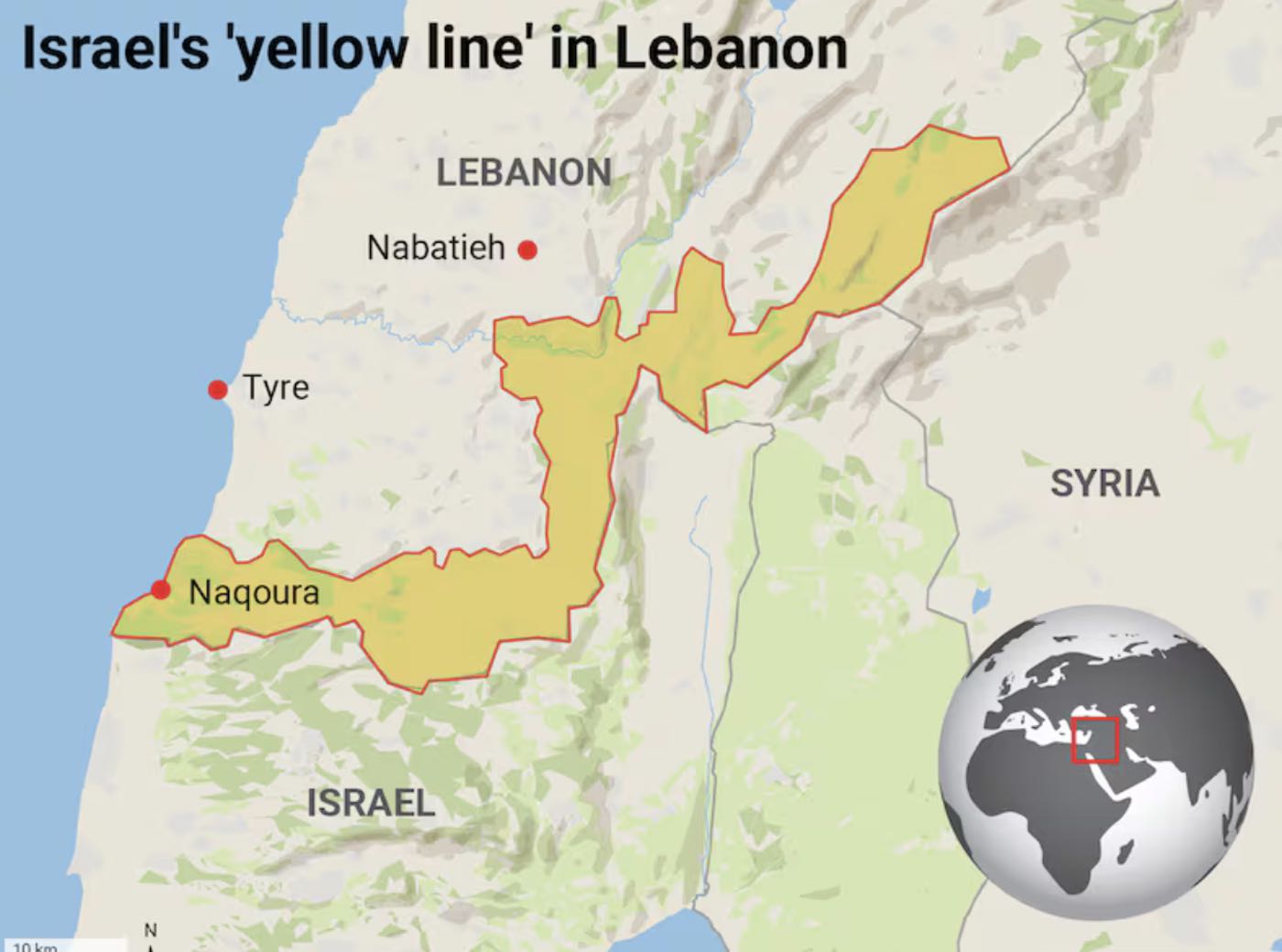
Israel’s Yellow Line in Lebanon, a so-called “security belt” where the Israelis have stationed troops and are systematically demolishing villages.
How do we stop the Israelis from bombing us? This question grips me every single day. But the most sober-minded people I know are just as perplexed as I am.
To attempt to understand logic of the Lebanese government and the shortfalls of its approach, we can consult an essay that was published in the Lebanese daily L’Orient–Le Jour on April 6, 2026. The title is “Neutrality, a Viable Lifeline for Lebanon.” This paper reflects the perspectives of some of the commentariat in Lebanon are saying, and the article represents a rare elaboration of the strategy that the Lebanese government is currently pursuing
The essay begins with this short preamble:
“The imagery of our army evacuating posts in the south while leaving behind villagers unwilling to abandon their homes in the face of Hezbollah-Israeli conflict and Israeli incursions raises an important question: what is the role of a state that cannot defend its borders from invasion and occupation?”
This question summarizes the basic contradiction. The government’s plan is to replace Hezbollah in the south with the national army, with the idea that the latter will protect civilians—but the author takes for granted that in fact, the army cannot do this. As we saw last month, the army withdrew immediately when the Israelis began invading. So in fact, there is no basis for the argument that monopolizing violence in the hands of the state will bring order and protection, even though that is the premise of the path that the government is taking.
The writer continues:
“The reality is much simpler: no army in the region can win at war with Israel; no proxy group can sell victory beyond survival; and Lebanon cannot function as a governable country—no matter how sophisticated its military capabilities—unless we dislodge ourselves, entirely, from regional war.”
But how could the Lebanese state dislodge Lebanon from the geopolitics of the surrounding region?
“… that requires adopting a policy too often misunderstood: neutrality. Neutrality is neither dismissing the Palestinian plight by throwing morals away nor equating anything with Israeli crimes. It is demanding that Lebanon no longer pay an enormous price for hosting the Arab-Israeli conflict, or in this more recent round, the Iranian regime’s survivability.”
The phrase “hosting the Arab-Israeli conflict” is particularly confusing. What could that mean? Where should it be “hosted”? How do we change “hosts”? The closest thing to a historical answer is the events of Black September (1970-1971), when Jordan violently expelled Palestinian groups to Lebanon. After that, in a sense, Jordanians did stop paying the aforementioned “enormous price,” but they simply pushed that cost onto Lebanon. How could Lebanon offload that onto some other polity? Surely the author isn’t suggesting that the Lebanese government should expel both Palestinians and its own citizens into Jordan or Syria?
Speaking of the “Arab-Israel conflict” as if it is a timeless abstraction makes no sense. The very language is the rhetoric of Zionists. Framing the war on Lebanon as the “Arab-Israeli conflict” ignores Lebanon’s particular history with Israel, presenting this war as the consequence of abstract Arab antagonism toward the state of Israel rather than a continuous, intentional, and carefully orchestrated expansion on the part of the Israeli state.
It is arguably true, as the author claims, that “no army in the region can win at war with Israel.” The failure of Arab states and societies to develop different means of engaging with this problem over the last several decades is one of the reasons we have arrived here. But this war has been imposed on us. It’s not our choice. The alternative, as we have seen time again, is surrender, occupation, humiliation. Or rather, the alternative to war is war by other means.
Armed resistance liberated the south of Lebanon in 2000—specifically, a strategy of asymmetrical warfare. They didn’t need to defeat the Israeli army, just as the Front de Libération Nationale (FLN) in Algeria didn’t need to defeat the French Army,29 just as the Vietcong didn’t need to defeat the American army.
What could a “policy of neutrality” mean? The proposal implies that the Lebanese government has the agency to determine what happens, but also, that neutrality is both possible and desirable in the face of a genocidal force. What mechanisms would serve to assert this neutrality? Are there any historical precedents to suggest this is even possible?
The writer’s sole example is the 1960s, when he claims that Lebanon was neutral and it worked. This claim is purely ahistorical. At the time, Israel was occupied elsewhere, fighting against Egypt. That was before the Palestinian revolution of 1965, before the crushing of Arab nationalism in 1967, before Black September in 1970, before the Arab-Egyptian peace treaty of 1977. It was only after those developments, when all other Arab states had been pacified and Palestinian militants had been expelled from those regimes, that Israel shifted the full force of its attention to Lebanon.
The period the writer refers to as a period of neutrality was also a period of harsh repression targeting Palestinians in Lebanon. Until the Cairo Agreement of 1969, they were living under what amounted to martial law.
This is a recurring theme throughout the region that the writer neglects to mention: neutrality comes at an internal cost. With substantial portions of the population opposing Israel, with many wanting to fight it militarily, the only way for states to prevent this is to crack down on their own populations via violent means. We can see this in Egypt’s authoritarian regime, in the Palestinian Authority, and in many other governments across the region. Instead of employing violence against the aggressor, Israel, these states turn that violence inward to repress those who would defend themselves as well as those who are moved to act in solidarity.
Those are in fact the stated ambitions of the current government in Lebanon. The president, Joseph Aoun, was elected on a platform of promising to monopolize arms in the hands of the state. However, it is clear that the Lebanese government cannot do that. The risk of civil war is too great.
So the writer proposes that Lebanon should be occupied by a new international force that would replace the United Nations Interim Force in Lebanon (UNIFIL):
“Where UNIFIL is unable to deliver, an alternative security arrangement should fill the void. Greater powers must support Lebanon in its desired transition away from permanent war…”
Without going into any detail about who those “great powers” might be, he confidently declares that they will ensure Lebanon becomes “neutral” and that “neutrality” will be:
“Lebanon’s shield—denying Israel a foothold on any single square meter of our geography. It remains our strongest defense.”
Why does the writer believe this? How could anyone believe this? This is not dealing with the material realities at all. Look at Syria, where the Sharaa administration is attempting to demonstrate its “neutrality.” That hasn’t stopped Israel from occupying more Syrian land, bombing the country on a regular basis, and fomenting sectarian conflict.
The writer’s only historical argument is that the siege of Beirut in 1982 ended after the expulsion of the PLO and the introduction of the Multi-National Force. He ignores the fact that it was popular armed resistance that liberated Beirut. He ignores the fact that even after the Israelis withdrew and the Multi-National Force remained, there was fierce resistance against the latter as well, eventually compelling them to retreat. He ignores the fact that even after the Israelis withdrew from Beirut, they continued to occupy the South of Lebanon for eighteen years, and that that occupation only ended after fierce and consistent resistance. Finally, he ignores the fact that the 1982 siege began as a violation of a 1981 ceasefire agreement. What would a new “international force”—inevitably, an American or European force—do to guarantee security for Lebanon when the Israelis violate international law day after day, year after year, decade after decade, with complete impunity?
The idea that what Lebanon needs is more imperialism is absolutely ridiculous.
After what we’ve seen the “international community” do in regards to Gaza, trusting them like this is delusional. Yet this seems to be the plan of the current Lebanese government. That is the premise of the current direct talks between Lebanon and Israel, which presumes good faith on the part of Israel (and the US) where there clearly is none. Lebanon has no leverage in this context. This is asking too much of people who have no cause to trust the US or Israel or the so-called international community—especially now with the US under Trump, who has demonstrated a complete disregard for international law. Are we supposed to work with the Board of Peace—the same people who suggested turning the entirety of South Lebanon into the Trump Economic Zone? Is this the viable alternative to Israeli occupation?
This type of thinking is pushing Lebanon towards civil war. It insults the inhabitants of Southern Lebanon, portraying them at best as deluded by Hezbollah or at worst as complicit in dragging the rest of the country into a conflict. Are they not Lebanese? Do _they_ not deserve sovereignty? Do they not deserve protection?
There are no easy answers as to how to accomplish protecting them. But it is certain that the kind of wishful thinking represented by the article in L’Orient–Le Jour is removed from reality and history. It serves no one. It can only perpetuate the confusion of the current moment and deepen the rifts that are already tearing apart the thin fabric of Lebanese society.
Conclusion
The government’s strategy is unpopular, dangerous, and doomed to fail. Resistance to the occupation is necessary; it is also a right under international law. Hezbollah is facing issues of legitimacy in the country, in many cases for very legitimate reasons. For example, one of the reasons that the author of the aforementioned article in L’Orient–Le Jour opposes Hezbollah is because Hezbollah killed his father. A lot of Lebanese politics boils down to longstanding sectarian conflict like this. That is the result of being ruled by a coalition of warlords for the last fifty years.
Many people are saying that there needs to be space to form a popular resistance movement similar to the Lebanese National Movement of the early 1970s. Such a movement would have to combine a program of anti-sectarian social cohesion, a revolutionary political program to overcome the sectarian oligarchy plaguing the country, a progressive economic program moving away from a financialized dependence economy, and an armed wing (whether of state or non-state forces) that could defend their communities from Israeli aggression. It would also have to stand in solidarity with Palestinians in their struggle for liberation.
This is another form of wishful thinking. Who would organize this? With what resources? Lebanon has been a playground for imperialist powers for so long now that it is difficult to imagine how any form of organizing could overcome that. Nonetheless, in view of the fundamental contradictions within the Zionist colonization of Bilad al-Sham and the colonial, capitalist, and exclusionary core of the Lebanese entity, nothing less will suffice. We can still attempt to think positively, to identify what we can fight for, not just against. That is the essential thing missing in this moment of despair and humiliation.
Israel wants to destroy Lebanon. We must all resist that by any means necessary. That means setting our priorities straight, it means unifying, it means forming communities based on common struggle. It means aiming for liberation, not just sovereignty. It also means forming connections of solidarity with other communities across the region and the world.
The beast that is setting upon Lebanon is global and our only hope is global resistance. The fire that started in Gaza is spreading now to Lebanon. But it will not stop there. It will consume all of us—all of you, as well—unless we extinguish it.
-
Moshe Dayan, Story of My Life, 1976 ↩
-
From an address given to Technion University students (March 19, 1969), a transcription of which appeared in Ha’aretz (April 4, 1969), quoted in The Question of Palestine (1980) by Edward Said, p. 14 ↩
-
Benny Morris, Israel’s Border Wars, p. 177. ↩
-
Ibid, p. 28. ↩
-
Avi Shlaim, The Iron Wall, p. 146. ↩
-
Tabitha Petran, The Struggle Over Lebanon, p. 142. ↩
-
Kamal Salibi, A House of Many Mansions_,_ 1987 ↩
-
Patrick Seale, Post-colonial Syria and Lebanon, 2007 ↩
-
Francis Stevension, Lloyd George: A Diary by Frances Stevenson, 1973 ↩
-
Illan Pappe, The Ethnic Cleansing of Palestine, 2006, p. 15 ↩
-
Ibid, p. 38 ↩
-
Ibid, p. 25 ↩
-
Fawaz Traboulsi, A History of Modern Lebanon, 2007, p.113 ↩
-
Mehdi Amel, On the Sectarian State, 1986 ↩
-
Hisham Safieddine, Banking on the State: The Financial Foundation of Lebanon, 2018 ↩
-
Mehdi Amel, On the Sectarian State, 1986 ↩
-
Benny Morris, Israel’s Border Wars, p. 28 ↩
-
Tabitha Petran, The Struggle Over Lebanon, p. 160 ↩
-
Part of a funeral oration Dayan gave in 1956 for a soldier killed on the front. ↩
-
Fawaz Traboulsi, A History of Modern Lebanon, 2007, p. 102 ↩
-
Ibid, p. 187 ↩
-
Ibid, p. 191 ↩
-
Ibid, p. 206 ↩
-
Tabitha Petran, The Struggle Over Lebanon, p. 242 ↩
-
Ibid, p. 260 ↩
-
Ibid, p. 278 ↩
-
David Hirst, Beware of Small States: Lebanon, Battleground of the Middle East, 2010, p. 192 ↩
-
Joseph Daher, Hezbollah: The Political Economy of the Party of God, 2016 ↩
-
Mahfoud Bennoune, The Making of Contemporary Algeria 1830-1987, 2002 ↩